Page 7 of 18

World Soil Day and the promotion of soil security

In 2002 the International Union of Soil Sciences (IUSS) declared 5 December as World Soil Day. Soil may not be glamorous, but it is a key component of our natural system, and a critical contributor to food, water and energy security through its role in mitigating biodiversity loss and climate change.

Soil - a very undervalued resource.(© All Rights Reserved)
Soil – a very undervalued resource.
(© All Rights Reserved)

Soil is vital to grow our food, to keep our livestock alive, and to keep our forests growing, which in turn keeps our environment healthy. On a human time scale, soils is a non-renewable resource, so sound soil management is extremely important. Sadly, despite this, soil is not high on most environmental decision making agendas – it is not a topic that makes for striking news headlines or wins elections.

Another factor pushing soil further down the agenda is increased urbanisation – with an ever growing percentage of the world population living in cities, soil is becoming less and less of a reality to most people.

World Soil Day aims to address this situation, by trying to raise the profile of soil and make people aware of the role it plays in a range of ecosystems.

Secure soil is the basis of a secure environment. In the words of American novelist and conservationist Wendell Berry, “The soil is the great connector of lives, the source and destination of all. It is the healer and restorer and resurrector, by which disease passes into health, age into youth, death into life. Without proper care for it we can have no community, because without proper care for it we can have no life.”
Dice, gambling and statistics

Today is Dice Day. Actually it is National Dice Day, a US-only event, but what the heck, I wasn’t able to find a more interesting international celebration for today, so we’ll just drop the ‘national’ and internationalise it for now, if you don’t mind.

A die (or dice, in the plural) is essentially a small object with multiple sides/resting positions, and with different numbers or symbols inscribed on its various sides. It is designed such that, when it comes to rest after being thrown, each resting position has a main, opposite upper side. The number/symbol on this side represents the number of the throw. Dice are often used in gambling games and in many popular board games.

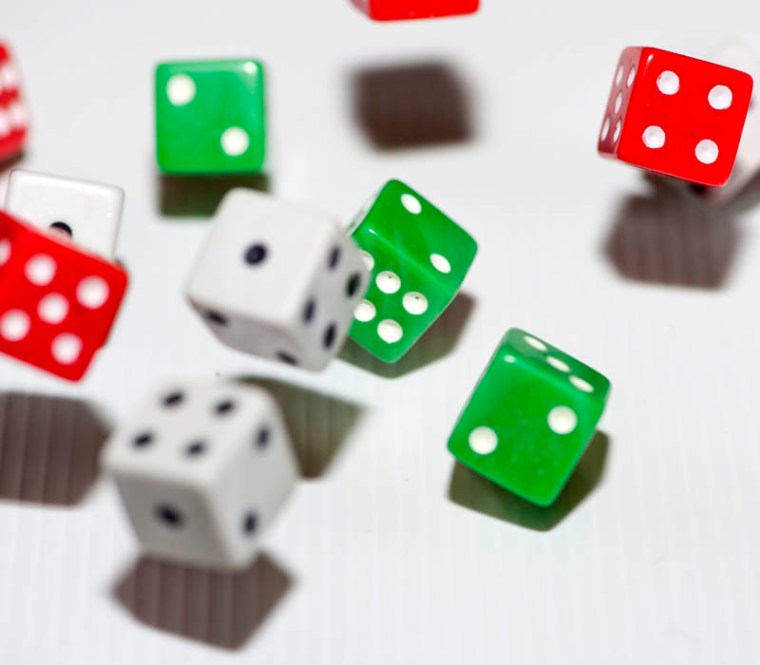
The more dice you throw, the more complex the maths can become.(© All Rights Reserved)
The more dice you throw, the more complex the maths can become.
(© All Rights Reserved)

The most common die is a standard, 6-sided cube, usually with slightly rounded corners, with a number of dots (ranging from 1 to 6) inscribed on each side. When thrown, each side of the die is equally likely to end up on top, the result thus being a random integer between 1 and 6. For specific games, multiple dice may be thrown at the same time, with the outcome given by the sum or combination of numbers on the dice.

Of course there’s no reason that a die has to be a cube. Various other equally valid shapes exist – tetrahedrons, octohedrons, dodecahedrons, and more. When you think about it, even a coin used in a coin-flip is essentially just a two-sided die.

Dice are not only useful for gambling and board games – they are also a very effective tool to teach and explain some rather complicated statistics, like conditional probability, that is, the probability that an event will occur given that another event has occurred.

Take the example where we throw two standard, 6-sided dice. The probability that the second die will land on a 1 is 1/6 (it can land on one of six values, all equally probable – simple enough). Now, what would be the probability that the second die lands on a 1, if we know that the first die landed on a 1? The answer is still 1/6, because the two events are independent.

Things change, however, if the events are no longer independent. For example, what is the chance that the total of the two dice will be less than 4, given that the first dice landed on a 1? Firstly, there are six possible values (1,2,3,4,5,6) for the second die given that the first die landed on a 1. Of these, however, only two options, 1+1 and 1+2, result in totals smaller than 4. So, the chance of the total of the two dice being less than 4, given that the first die landed on a 1, is 2//6, or 1/3.

Formally expressed, p(total < 4 | die1 = 1) = 1/3.

There you have it – just when you thought you were safe in the knowledge that we were going to stick to chatting about harmless things like gambling and board games, you got flashed by a lesson in statistics…

Sneaky little buggers, these dice! 🙂

John Backus and the development of high-level computer programming languages

Today we’re celebrating the birthday of John Backus (3 Dec 1924 – 28 Oct 1988), American computer scientist and the leader of the team who invented the Fortran programming language (at the time called FORTRAN) while working at IBM in the mid 1950s.

Fortran was the first so-called ‘high-level computer language’, which means it was capable of converting standard mathematical formulas and English-based expressions into binary code used by computers. The language is particularly suited to scientific computing and numeric computation. Over the years, many improvements were made to the original Fortran language, with versions known by a sometimes strange series of numeric identifiers – FORTRAN, FORTRAN II, FORTRAN III, FORTRAN IV, FORTRAN 66, FORTRAN 77, Fortran 90, Fortran 2003 and Fortran 2008.

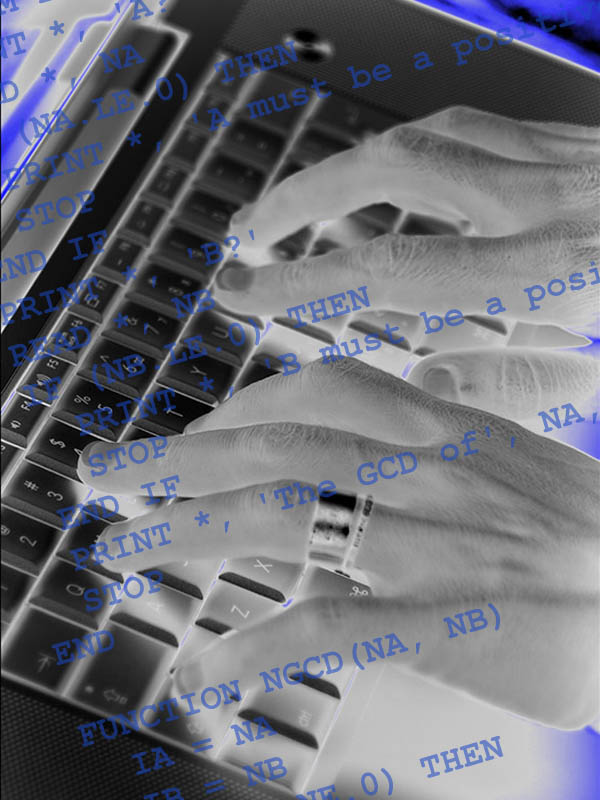
FORTRAN was the first widely used high-level computer language, providing an interface between equations and expressions understandable to humans,  and binary code used by computers.(© All Rights Reserved)
FORTRAN was the first widely used high-level computer language, providing an interface between equations and expressions understandable to humans, and binary code used by computers.
(© All Rights Reserved)

Despite being one of the oldest computer languages, it has been one of the most enduring, and after more than half a century it is still a preferred language for computationally intensive applications such as weather prediction, computational fluid dynamics and finite element analysis. One of the reasons for Fortran’s longevity is that some of the later Fortran compilers in particular are capable of generating very fast and efficient code, which can make a big difference when solving large, complex mathematical computations. It is still the primary language for used on many supercomputers, and many of the floating-point benchmarks to test the performance of new processors are still written in Fortran.

As a high-level language, Fortran has also provided an impetus for the development of numerous subsequent computer languages such as ALGOL, COBOL and BASIC.

The IEEE awarded John Backus the W.W. McDowell Award in 1967 for the development of FORTRAN. He also received the National Medal of Science in 1975 and the ACM Turing Award in 1977 for his contributions to the design of high-level computer programming systems.

It’s World Computer Literacy Day

A couple of days ago I commented on Computer Security Day. Today we’re back to computers, but this time the issue is way more fundamental – today is World Computer Literacy Day.

Celebrated for the first time in 2001 in India, the day has since expanded to an international initiative. Computer literacy relates to the ability to comfortably use computers and related information and communications technologies (ICTs). Some of the key issues impacting computer literacy include basic access to ICT, and the ability to use these technologies in your own language.

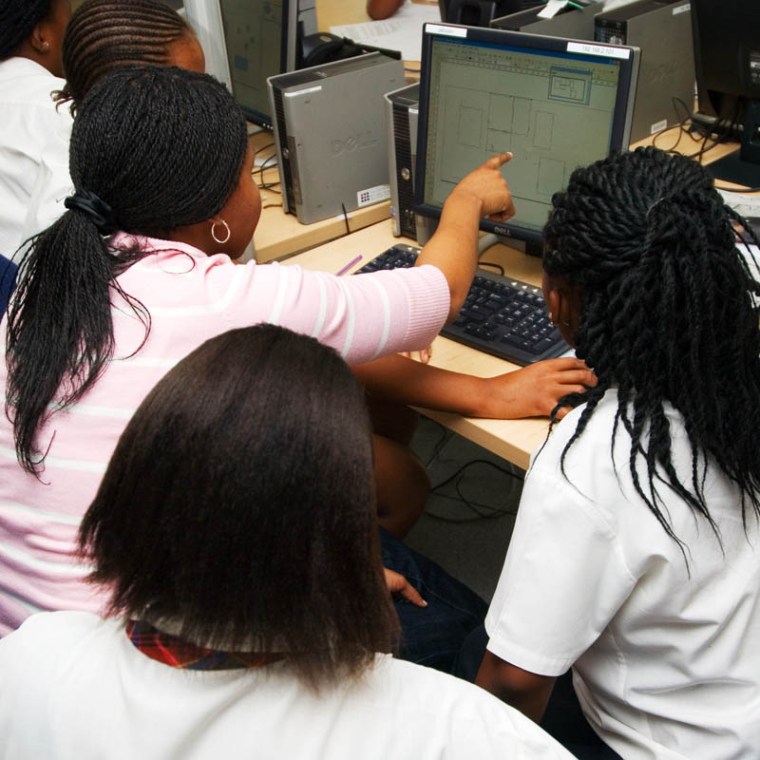
Promoting computer literacy and connectivity in the developing world is critical in creating economic opportunities for all.(© All Rights Reserved)
Promoting computer literacy and connectivity in the developing world is critical in creating economic opportunities for all.
(© All Rights Reserved)

In an attempt to raise awareness about the plight of those who are not privileged enough to have access to computers, Irish charity organisation Camara Education has launched a challenge to those of us for whom ICT is a part of everyday life, to go without technology for 24 hours. Through this initiative, known as ‘Techfast’, they hope to highlight the digital divide that still exists in the world today.

Being connected always and everywhere, it is easy to forget that the global digital village we are part of really isn’t that global at all, with ICT and computer literacy very much concentrated in developed countries. While we get treated to high speed, low cost Internet, the developing world continues to lag further and further behind.

There are positive examples in the developing world where the digital divide is actively being addressed. While countries like Ethiopia and Zambia still have less than 2% of the population connected to the Internet, the situation in Kenya, for example, looks very different – from 2009 to 2010 the percentage of Internet users have increased from 10% to 26%. A massive digital boom indeed, and one which is reported to also be providing an economic boost to the country.

While I often wonder whether 24/7 connectivity is a blessing or a curse, the fact of the matter is that, to participate in the global economy, connectivity and computer literacy is of paramount importance.

While you’re comfortably browsing through your blog roll on your high-speed internet connection, spare a thought on World Computer Literacy Day for those who are not as technologically privileged.

Christian Doppler and the sound of speeding vehicles

Today we celebrate the birthday of Christian Doppler (29 Nov 1803 – 17 Mar 1853), the Austrian physicist who first described how the observed frequency of sound and light waves are affected by the movement of the source of the waves relative to the observer. The phenomena became known as the Doppler effect.

Simply put, sound and light waves would have a higher perceived frequency if the source was moving toward the observer and a lower perceived freqency if the source was moving away from the observer.

No matter how cool the rider, your Harley will still have a slightly more girly pitch as it races towards the observer.
(© All Rights Reserved)

It is said that Doppler first tested his hypothesis by using two groups of trumpeters – one group stationary on a train station, and the other group on an open train car. Instructing them to all play the same single note, he found that, as the open car passed the station, the pitch of the two groups did not match. Approaching the station the trumpeters on the train appeared to play a higher note, and leaving the station they appeared to play a lower note.

One of the places where the Doppler effect is very obvious is at a motor racing event – I am sure everyone has heard (either live or on TV) the effect of the sound of a racing car, or motorbike, changing quite dramatically as it comes screaming past. As the car races forward, the sound waves emanating from the engine effectively gets compressed in front of the car, resulting in a higher pitched sound, while they get spread out behind the car, producing a lower pitch.

Because the extent to which the frequency changes is dependent on the relative velocity of the source, observed changes in frequency can be used to calculate the speed at which the source is traveling.

The Doppler effect finds application in a wide range of fields, from astronomy to radar to medical imaging to flow measurement to satellite communication and more.

As mentioned before the effect does not apply to sound only – it applies to all waveforms, including light. A light source moving towards the observer will appear to have a higher frequency than one moving away from the observer. However, because very high speeds are required to achieve an effect visible to the human eye, this is less easy to observe than the sound example.

There’s a classic physics joke that says the most effective way to observe the optical Doppler effect is to look at cars at night – coming towards you, their lights are all white, while moving away from you, their lights are red!  (Think about it, it makes perfect sense…) 🙂

Celebrating Anders Celsius and his temperature scale

Today we celebrate the birthday of Anders Celsius (27 Nov 1701 – 25 Apr 1744), the Swedish astronomer who gained fame for developing the Celsius temperature scale.

Celcius’ original scale defined 0 °C as the temperature where water freezes, and 100 °C as the temperature where water boils (at one standard atmosphere). This was the definition of the scale until 1954, and remains a useful, pretty accurate approximation, and is still taught in most schools today. However, to be exact, the Celsius scale is currently no longer defined by the freezing and boiling point of water, but rather by the absolute zero temperature and the triple point of purified water. The absolute zero point is defined as -273.15 °C, and the triple point as 0.01 °C.

It’s boiling water, but it sure ain’t 100 °C.
(© All Rights Reserved)

Based on this slightly redefined scale, the real freezing point of purified water is -0.0001 °C, and its boiling point is 99.9839 °C. Of course these values only apply at exactly one standard atmosphere pressure (approximately sea level) and with specially purified water, so actual ‘real life’ freezing and boiling points only approximate 0 °C and 100 °C anyway. An altitude change of as little as 28 cm causes the boiling point of purified water to change by a thousandth of a degree.

Interestingly, the rule set forth by the International Bureau of Weights and Measures for writing Celsius values (most units of measure, in fact), is to write the numerical value, followed by a space, followed by the °C sign. So the correct way to write a temperature is 37 °C, not 37°C or 37° C.

Currently the Celsius scale is the temperature scale most widely used for all kinds of purposes. Only the United States (bless them) and a handful of other countries still give preference to the Fahrenheit scale. The UK also used to prefer the Fahrenheit scale, but over the last half century the Celsius scale has gained dominance (although they prefer calling it centigrade).

So, whether you prefer an icy, a close to 0°C Scotch on the rocks, or an almost boiling, close to 100 °C cup of coffee or tea, join me in a toast for Anders Celsius, the man who defined it all in the first place.

About energy fields and coloured glows

Today is International Aura Awareness Day, celebrated each year on the fourth Saturday of November.

According to the Merriam-Webster Dictionary, an aura can be defined as:

  • a subtle sensory stimulus (as an aroma)
  • a distinctive atmosphere surrounding a given source (for example, “the place had an aura of mystery”)
  • a luminous radiation : nimbus
  • a subjective sensation (as of lights) experienced before an attack of some disorders (as epilepsy or a migraine)
  • an energy field that is held to emanate from a living being

International Aura Awareness Day relates mainly to the last definition above – that coloured radiant glow or energy field said to surround people or objects.

If you had an aura, what colour do you think it would be?
(© All Rights Reserved)

Some people claim they can see auras; some claim they can teach others to see auras; some say you can interact with your own aura; some even claim they can photograph auras. The rest of us, unfortunately, have to take it all with a grain of salt. No scientific evidence exists to support the supposed abilities of the aura-seeing clairvoyants, and the claims of aura-capturing photographic technologies are questionable to say the least.

However, if auras do exist (and who am I to claim otherwise), I wish everyone a day of peaceful soft-blue aural energy.

Peace out, brothers and sisters! 😉

Looking at the world through a child’s eyes

Today is Universal Children’s Day – established by the UN to promote the welfare of the children of the world. While the ‘generic’ day is celebrated on 20 November, many countries have special Children’s Day’s celebrated throughout the year.

Children are key to all the strategies and activities of the UN – the UN’s Millennium Development Goals (MDGs), while aimed at benefiting all of humankind, are primarily focused on children. As UNICEF notes, “six of the eight goals relate directly to children and meeting the last two will also make critical improvements in their lives.”

“There can be no keener revelation of a society’s soul than the way in which it treats its children” – Nelson Mandela
(© All Rights Reserved)

From an adult point of view, another important benefit of this day is that it reminds us of the innocence and wonder of being young. It reminds us that we don’t always have to over-complicate matters; that sometimes the best strategy is to approach matters afresh, with curiosity and without prejudice, the way children do by default.

This applies in life, as in the sciences. To quote physicist Frederick Seitz: “A good scientist is a person in whom the childhood quality of perennial curiosity lingers on. Once he gets an answer, he has other questions.” Marie Curie shared this sentiment when she said: “I am among those who think that science has great beauty. A scientist in his laboratory is not only a technician: he is also a child placed before natural phenomena which impress him like a fairy tale.”

So, on this day, consider the children – may their best interest guide your actions, and may their example inform your ways. Happy Universal Children’s Day!

Show that you give a shit on World Toilet Day

Today, 19 November, we celebrate World Toilet Day. Together with Global Handwashing Day, that I wrote about some time ago, these two days represent the main ‘personal hygiene for health’ days celebrated annually.

Sadly, despite its importance from a health point of view, the day is also one of the most ridiculed annual observances (toilet humour rules, I guess), to such an extent that the United Nations Regional Information Centre (UNRIC) has even published an ‘International stop-making-fun-of-world-toilet day!’ page.

Considering the huge health impact that basic sanitaton can make to preserving human health, this is indeed no laughing matter. According to UN figures, about 4000 children die every day as a result of a disease directly related to poor sanitation. That equates to a death almost every 20 seconds – more than the combined deaths caused by HIV AIDS, malaria and measles.

Millions of children, mainly in the developing world, rely of primitive, shared toilets for their basic sanitation requirements. And these are the ‘lucky ones’, given that millions more have no access to a toilet at all.
(© All Rights Reserved)

Given the above, global provision of basic sanitation is a key target underlying the UN’s Millennium Development Goal (MDG) of ‘Reducing by two thirds, between 1990 and 2015, the under-five mortality rate’. It is, unfortunately, also the area where the least progress has been made, mainly because the sanitation sector is desperately under-funded (probably as a result of it being a much less ‘glamorous’ cause than HIV AIDS etc).

According to Catarina de Albuquerque, UN Human Rights Rapporteur on Water and Sanitation, it was estimated in 2006 that almost $15 billion will be required annually to provide universal access to sanitation by 2015. By now, with the target date being so much closer, I am sure that number is much higher. Currently, 2.5 billion people still do not have access to a private toilet, and 1.1 billion people defacate in the open, with no sanitation system in place to address this pollution. That means one in three people do not have access to a private toilet, and one in seven have no access to a toilet at all. It is a humanitarian crisis touching the basic dignity of billions worldwide.

Many public, shared toilet facilities do little to facilitate basic human dignity, often being open, shared spaces with little or no privacy.
(© All Rights Reserved)

Unlike complex diseases, sanitation is a ‘simple’ problem – it is easy to solve if only enough money is made available. As such, it is one of those areas where widespread public awareness campaigning can actually make a difference, to force governments into addressing and funding the problem.  To this end, a punchy awareness campagin has been launched under the theme of ‘I give a shit, do you?’, and tweets around the topic can be tagged with the hashtag #IGiveAShit to extend its reach and potential impact.

So, show that you give a shit, and start talking about sanitation. It may be a crappy subject, but as long as it is not addressed, millions of people will continue to die unnecessary deaths, deaths that can so easily be avoided. For suggestions about how to get involved, visit the World Toilet Day action page.

To get you started, here’s a neat little YouTube video about World Toilet Day – please have a look, and share widely:


Celebrating August Möbius and his crazy, twisty Möbius strips

Today we celebrate the birth of August Möbius (17 Nov 1790 – 26 Sep 1868), German astronomer, mathematician and author, and the man who introduced the concept of the Möbius Strip, one of the more interesting objects in mathematical topology.

Getting into the mathematics behind the Möbius strip is beyond the scope of this blog, but suffice to say that a Möbius strip is a two dimensional surface with only one side. Mathematically it is said to be a non-orientable object.

The one-sided, non-orientable Möbius strip.
(© All Rights Reserved)

A physical model of a Möbius strip can be constructed by taking a long, rectangular strip of paper, giving it a 180 degree half-twist and joining the ends together to form a loop.  Starting at any point on the surface of the resultant loop, you can draw a line along its centre, passing along both sides of the strip and eventually returning to your original starting point, without once lifting your pen.

Moreover, cutting the Möbius strip along this centre line with a pair of scissors will not result in two separate loops, but rather a single loop, double the length of the original, and with two full twists in it. Thanks to having an even number of twists, the resultant loop will not be a Möbius strip anymore – if you draw a line along its centre, you will remain on one side of the strip, and the line will not traverse both sides.

If you repeat the cutting exercise and cut this new loop along its centre, you will end up with two separate loops, wound through each other, and each having two full twists.

Getting back to our original Möbius strip, another ‘trick’ is to make your cut 1/3 from the one edge. If you keep cutting until reaching your original point, you end up with two loops – one new, thin Möbius strip (the center third of the original), which will be the same length as the original, and one thin loop with two twists and twice the length of the original.

In the same way that a Möbius strip (with 1 half-twist) when bisected, results in a new loop with 2 full twists, loops with more half-twists will lead to different end results. Generally speaking, a loop with N half-twists (where N is an odd number), when cut along its centre, becomes a loop with N+1 full twists.

These crazy, twisty loops are not only amusing things to cut up and play with – they have lots of useful practical applications. When designed in the shape of a Möbius strip, conveyer belts can be made to last longer, as wear and tear will be shared between the two sides. Similarly, typewriter ribbons can be more effective when shaped with a half-twist. Möbius strips, with their unique geometry, also occur in physics and chemistry, and even have applications in electric circuitry.

Amusing things indeed, and surely well deserving of their own special day!