Page 23 of 34

Looking forward to a brighter, clearer future on World Sight Day

Today we celebrate World Sight Day, an annual day drawing attention to blindness, visual impairment and rehabilitation of the visually impaired. Globally, it is estimated that almost 300 million people suffer from severe visual impairment (blindness and low vision). About 90% of these live in developing countries.

There are many factors that cause chronic blindness. These include cataract, glaucoma, age-related macular degeneration, corneal opacities, diabetic retinopathy, trachoma, and eye conditions in children (e.g. caused by vitamin A deficiency). Uncontrolled diabetes is the main factor contributing to age-related blindness in both developed and developing countries.

The age groups most affected by visual impairment are people over the age of 50 (who suffer mainly from age-related impairments) and children below the age of 15 (mostly due to refractive errors – myopia, hyperopia or astigmatism).

A gentle reminder of the world through the eyes of the visually impaired. And this would be classified as mild impairment.
(© All Rights Reserved)

A very important fact worth noting is that more than three quarters of all blindness is preventable or curable. Children in low and middle-income countries in particular are often victims of preventable eye diseases – diseases that, if left untreated, can lead to irreversible blindness. The WHO, in partnership with LIONS Club International, six years ago launched a worldwide, multi-year project to address curable diseases in children – an effort that has so far helped more than 100 million children through increased access to eye care in 30 countries. Many interventions are very basic, such as screening babies and children for eye problems as early as possible. Yet these can have a huge impact, because the earlier any problems are identified, the easier they typically are to address.

Looking at the past 20 years, things are definitely looking positive.  Worldwide, visual impairment is decreasing, despite an aging population. This is largely due to the increased effectiveness in treatment of infectious diseases.  Many countries have also made progress in terms of the establishment of nationally coordinated programmes to address visual impairment, greater focus on eye care in primary and secondary health care, awareness campaigns including school-based education, and stronger involvement of the private sector and civil society. There are also global initiatives like “Vision 2020: The Right to Sight”, created by the World Health Organization (WHO) and the International Agency for the Prevention of Blindness, that are doing amazing work to address the issues that still remain.

So while the problem remains huge, it’s nice to at least be able to say “It’s getting better.”  Definitely a good reason for celebration on World Sight Day!

World Mental Health Day and the global crisis of depression

Today, 10 October, is World Mental Health Day. This day, sanctioned by the World Health Organisation, raises public awareness about mental health issues. The aim is to stimulate open discussion of mental disorders and to promote investment into treatment and prevention services.

The theme for 2012 is “Depression: A Global Crisis”. In support of this, the World Federation for Mental Health (WFMH) has compiled a highly informative PDF document on World Mental Health Day and on depression in particular – well worth a read.

Depression – a mental disorder that involves depressed mood, loss of interest, decreased energy, feelings of guilt and reduced self-esteem, disturbed sleep, suppressed appetite, reduced concentration and heightened anxiety – is indeed a crisis of global proportions, with a reported number of 350 million people worldwide suffering from some form of depression. That’s almost 1 in 20 people worldwide.

While various forms of treatment exist – including basic psychosocial support combined with antidepressant medication or psychotherapy such as cognitive behaviour therapy, interpersonal psychotherapy or problem-solving treatment – depression is often not correctly diagnosed and access to treatment remains a problem, especially in the developing world. It is estimated that in some areas less than 10% of depression sufferers receive treatment.

Bipolar affective disorder, a severe form of depression, involves disruptive mood swings between frenzied manic states and episodes of deep depression.
(© All Rights Reserved)

In a way we are faced with polar opposite problems in the developed and developing world when it comes to treating depression. In the developing world, the disease is often not correctly diagnosed, and the necessary medication is not available, or there aren’t suitably trained caregivers to assist with the required therapy.  In the developed world, on the other hand, I personally think we tend to ‘grab the pills’ way to quickly. While antidepressant medication is a key component in the treatment of severe depression, what is worrying is the extent to which it is willy-nilly dished out to anyone and everyone who feels a bit down. Almost like the injudicious prescription of antibiotics for anything from a mild flu, when all that’s needed is some rest and recovery time, we are becoming a population popping ‘happy pills’ when the problem could be solved successfully, and with less side-effects, through therapy and even self-help approaches including regular exercise, maintaining a healthy diet, relaxation techniques, a regular sleeping routine, creating a stable daily routine, etc. As reported by the WFMH, “Innovative approaches involving self-help books or internet-based self-help programs have been shown to help reduce or treat depression in numerous studies in Western countries.”

While antidepressant medication is an important component in the treatment of moderate to severe depression, milder forms of the disease can be effectively treated through self-help treatments including regular exercise and healthy eating.
(© All Rights Reserved)

On this day, spare a thought for the millions of people suffering from depression, and do what you can to be there and to support those needing our help.  If you feel you may be suffering from the disease, don’t hesitate to seek help – it can be treated. And make sure to get an informed opinion before necessarily opting for medication – there are many potentially less harmful alternative treatments out there.

To quote the WFMH, “On an individual, community, and national level, it is time to educate ourselves about depression and support those who are suffering from this mental disorder.”

World Post Day and the challenge of the digital era

Today we celebrate World Post Day. This UN observance commemorates the establishment of the Universal Postal Union (UPU), headquartered in the Swiss capital Berne. Established in 1874, the UPU is the second oldest international organisation in the world.

Worid Post Day aims to create awareness of the role of the postal service in our business and personal lives, with many post offices hosting special events like open days, poster displays etc. New stamps are also often issued on this day.

In this digital era, where instant connectivity is taken as a given, the traditional postal services are facing some of the biggest challenges in their long history. With the pervasiveness of email and social media, the average person has less and less reason to interact with paper-based hard copy post. Letters happen on email; birthday cards whizz around electronically, bills arrive in you email and get paid via online banking. And junkmail – the heaps of colourful paper brochures filling up your mailbox and trying to tempt you into parting with your hard-earned cash, are more and more changing to digital format and distributed using new strategies like electronic viral marketing.

Are mailboxes like these on the verge of extinction?
(© All Rights Reserved)

These changes have already resulted in announcements from the US Postal Service that more than 220 mail processing facilities would be closed or consolidated in 2012/13 as part of a three-year, $15 billion cost-cutting plan.

In response to this challenge, the US Postal Service’s Risk Analysis Research Center (RARC) recently initiated a project to “study the impact of the digital revolution on the future of the American postal ecosystem.” In the report generated from this study, a range of strategy suggestions are made, and the report concludes “The Postal Service has the opportunity to extend its national platform into the digital world and enable traditional service providers, as well as new entrepreneurial ‘applications developers’, to generate a wide array of additional physical and digital postal services to meet the present and future needs of digital natives and digital migrants.”

One of the specific services being suggested is an ‘eMailbox’, a “single official U.S. Mail branded e-mail box” where every citizen will have a permanent address, linked to their physical address, providing the postal service the flexibility to deliver both physical and electronic mail. Also suggested is a Postal Service hosted ‘eGovernment platform’ to serve as an integrative platform underpinning the digital communications strategies being initiated in different federal departments and programs.

A suggestion that I find quite interesting is a ‘Hybrid and Reverse Hybrid Mail’ service. which could play a role in bridging digital divides by offering ‘digital to physical’ and ‘physical to digital’ mail conversion services, enabling those who do not have direct access to digital technologies to still interact with the digital world.

A ‘Hot Mail’ mailbox – a cheeky comment on the digital revolution.
(© All Rights Reserved)

If the suggestions from the above report can work for the US Postal Service, similar changes may likely follow in other countries, and developing countries in particular may gain huge value from the hybrid and reverse hybrid approach.

Whatever the outcome, we can be sure that postal services the world over will see massive changes over the coming years. I would be very interested to get a peek into the future to see what the post office will look like in 2030!

Harry Day and the great fluoride debate

Today we celebrate the birthday of one Harry Gilbert Day.

Harry Day, a nutritional biochemist, helped develop the fluoride additive used in toothpaste to combat tooth decay. The research by Day and his colleagues at Indiana University in the US was funded by Proctor and Gamble (P&G). Stannous fluoride was approved as a tooth paste additive by the US Food and Drug Administration in 1955, and introduced to the public for the first time in a commercial toothpaste by P&G in 1956.

Since its first introduction, fluoride in toothpaste has been the subject of heated debate. The pro-fluoride lobby holds that fluoride is important to prevent tooth decay and, while it can be acutely toxic if swallowed in large amounts, even ‘full strength/adult’ brands of toothpaste contain low enough levels of fluoride to not pose any health risks. Anti-fluoride campaigners, on the other hand, point to a range of scary issues related to the additive. Dementia in humans, due to exposure to fluoride, is said to double in the next two decades, and triple in three. Excess fluoride is also claimed to cause teeth to discolour and crumble, to have detrimental effects on the musculoskeletal and nervous systems, and according to some studies, even lead to bone cancer.

Fluoridation of toothpaste – definitely not a black and white issue.
(© All Rights Reserved)

One of the main arguments against fluoride as a toothpaste additive is that it is already included as an additive in much of the world’s drinking water and in mineral and vitamin supplements, and that the combined levels we are exposed to exceed what is safe.

As a result of the debate, more and more non-fluoride toothpastes are being introduced to the market, allowing both sides of the argument access to their preferred option.

As Shakespeare might have said if he was around today: “To fluoridate or not to fluoridate, that is the question.” What is your view on the subject?

World Day for Decent Work and the time bomb of youth unemployment

After days dedicated to smiling and fun, we return to the serious subject of work – today is World Day for Decent Work. On this day trade unions and other workers associations promote the concept of Decent Work, defined by the International Labour Organisation (ILO) as “work that is productive and delivers a fair income, security in the workplace and social protection for families, better prospects for personal development and social integration, freedom for people to express their concerns, organize and participate in the decisions that affect their lives and equality of opportunity and treatment for all women and men”. Activities celebrating the day range from demonstrations to music events to conferences.

This day was launched as part of a larger Decent Work, Decent Life campaign at the World Social Forum in Nairobi in 2007 by five organisations: Solidar, the International Trade Union Confederation (ITUC), the European Trade Union Confederation (ETUC), Social Alert International and the Global Progressive Forum. Since then, it has been organised annually by ITUC.

Millions of people globally are engaged in informal or temporary employment.
(© All Rights Reserved)

The global economic crisis is still negatively impacting the working class worldwide, and having a particularly brutal impact on young people who lack the necessary work experience to ensure decent jobs, and who are often among the first to be laid off, being the workers with the least seniority. In addressing this problem, the importance of education can of course not be overstated, but often even university degrees and theoretical knowledge is not enough to secure decent employment.

Figures indicate about 75 million young people around the world being without jobs, and millions more caught in informal or temporary employment. Youth unemployment in some countries, particularly in the developing world, has reached levels of up to 60% – a situation that is rightfully considered a social and economic time bomb. A report “The Social Crisis Behind the Economic Crisis – the Millions of Young People Unemployed”was released at the ITUC Youth Committee meeting earlier in the year, focusing on the situation of young European workers and the answers from the trade union movement to the problems they face.

Finding and keeping a job as a young worker can be a very tough challenge.
(© All Rights Reserved)

This is a massive problem, and one with no obvious, easy solution. One of the ‘citizen actions’ being proposed by the ITUC is for as many as possible people to make themselves heard on the subject, to force action at government level. A very cool way to do this is through the Work Forecast initiative. The Work Forecast website puts you in contact with the Labour Minister in your country, empowering you to ‘take action’. You can tweet your support for improved labour conditions, send your minister a message, or even view his/her facebook page (if they have one).

Go ahead, keep them on their toes – check out your Labour Minister, and let them know how you feel.

Having fun without breaking the bank on Frugal Fun Day

Following hot on the heels of World Smile Day comes Frugal Fun Day, celebrated on the first Saturday of October. As far as I could ascertain, Frugal Fun Day – a day to engage in fun activities that are either free or very inexpensive – is the brainchild of Seth Horowitz, author of “The Penny-Pinching Hedonist: How to Live Like Royalty With a Peasant’s Pocketbook.”

The idea of the day is to try and come up with original, imaginative ways to have fun without breaking the bank. Build your own kite and try to fly it. Pitch a tent in the garden and ‘go camping’ for the night. Go play in a sand-pit (or better still, the beach, if you’re lucky enough to live near the sea). Lose yourself in a good book from the library or bought at a secondhand shop. Hold a family concert. Visit museums and art galleries in your region. Go support a school sports event, even if your kid isn’t playing. Use the power of social media and arrange a flash mob.

Want some frugal fun? Invent a new game or sport! Uhm, anyone up for some beach ballet?
(© All Rights Reserved)

If you strongly feel you want to spend your time more constructively, you can have your frugal fun by helping others. Find out about volunteering opportunities and activities in your region and get involved. Few things leave a more lasting good feeling than doing good to others.

If you let your imagination run free, the possibilities are endless – I am sure you can think of many more exciting things to do than I’ve come up with.

Focussing our creative energies on simple, constructive fun is a great way to get away from the stresses of modern life – you probably need less than an hour watching the news of the world to be convinced just how much we all need it. And focussing specifically on the cheap and free side of things is a good reminder that money is not always a prerequisite for enjoying ourselves.

So the challenge is yours – any suggestions?

World Smile Day: Do an act of kindness. Help one person smile!

Today, being the first Friday of October, is World Smile Day. The idea for the day comes from Harvey Ball, artist from Worcester Massachusetts USA, and the guy whose claim to fame is the creation of the iconic Smiley Face in 1963.

(Pumbaa, Wikimedia Commons)

As the smiley face gained popularity, Ball felt it lost its original meaning. This resulted to the creation of World Smile Day – the smiley face shows no discrimination in terms of politics, geography or religion, and Ball felt that, for at least one day a year, we should put aside our prejudices as well. World Smile Day asks of you to “Do an act of kindness. Help one person smile!”

When Ball died in 2001, the Harvey Ball World Smile Foundation was created in his honour. The foundation, whose slogan is “Improving this world, one smile at a time”, remains the official sponsor of World Smile Day activities in Ball’s hometown.

On the subject of smiling – earlier in the year, on SCUD Day, I wrote a blog post about the psychological benefits of smiling, and how even just pulling your face into a smile can ‘fool’ you into feeling better.  It seems, however, that the benefits of smiling does not stop there.

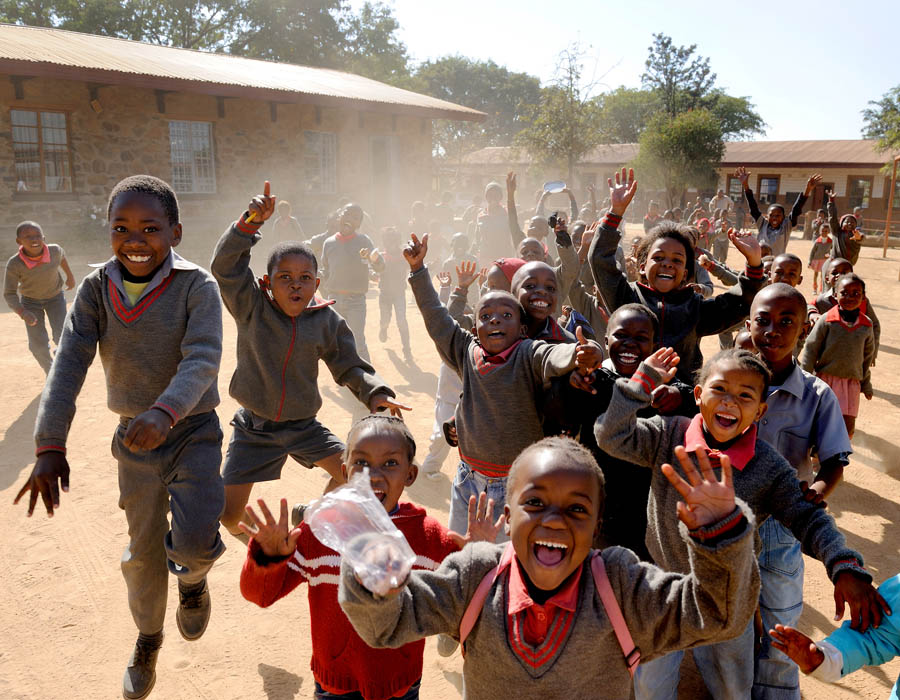
Conclusive proof of the contagious nature of a smile – it’s impossible to not smile while looking at these happy faces!
(© All Rights Reserved)

I found an excellent article on the Forbes website, where Ron Gutman, founder and CEO of HealthTap, discusses many of the scientifically researched benefits of smiling. Here’s some of the results I found particularly interesting:

A 30-year longitudinal study done at the University of California Berkeley measured smiles of students in old yearbooks, and used this to predict future happiness – how happy their marriages would be, how well they would score on standardized well-being and happiness tests, and how they would inspire others. It turns out, perhaps not surprisingly, that the widest smilers in college turned out to be the happiest people in life.

A similar study at Wayne State University looked at baseball card photos of Major League players from 1952, and found that the span of their smiles served as a fairly accurate prediction of life-expectancy! The non-smilers lived to an average age of almost 73, while the smilers on average made it to almost 80.

Smiling is one of the most basic, and most universal, human expressions. In cultural studies on Papua New Guinea’s Fore Tribe, who had no contact with western culture and is known for their cannibalism, it was found that even in that very remote culture smiles were used very similar to how we use it.

Studies done in Sweden show that other people’s smiles suppress the control we usually have over our own facial muscles, causing us to smile involuntarily. Apparently it is also very difficult to frown when looking at someone smiling.

And here’s the clincher – according to a UK research study, it was found that a smile could generate an equivalent amount of ‘feel good activity’ in the brain as 2000 chocolate bars!

Have a look at Gutman’s article – it’s a most amusing read.

Have a brilliant World Smile Day, everybody. I think the wise Mother Teresa said it best: “Everytime you smile at someone, it is an action of love, a gift to that person, a beautiful thing.”

World Pet Day, and the pros and cons of owning a pet

It is World Pet Day today. Actually, according to some sources it is World Animal Day, which is a significantly wider concept, but for the sake of this post let’s stick to pets.

The decision to get a pet can be quite a significant one. For many it’s a no-brainer, they couldn’t fathom the idea of not having a pet in the house. But at the same time it is a huge responsibility – more so than many people unfortunately realise.  Personally, being a freelance photographer who is regularly away from home on assignments across New Zealand, a pet would complicate things – I need to maintain a lock-up-and-go lifestyle. And having to check your pet into a kennels or cattery each time is a traumatic experience of both pet and owner.

Pets can have various health benefits, not least of all the fact that they make you get out and exercise more.
(© All Rights Reserved)

There’s a lot to be said for getting a pet. According to an article in the Los Angeles Times, for example, Dr Froma Walsh of the Center for Family Health at the University of Chicago says that “having a pet can meet many human psychosocial needs and has been undervalued in the field of mental health.” Pets reduce stress through the companionship and unconditional love they give their owners. According to Dr Walsh, heart attack survivors who have pets are likely to live longer. Relationships with pets help people through hard times and “provide connectedness in an era when family connections are fragmented.”

There’s a plethora of articles claiming health benefits from pet ownership – these range from decreased risk of heart attack and lower blood pressure, to positive psychological benefits.  I am sure most pet lovers will agree that their pets are beneficial to their health and well-being.

Interestingly enough, however, a recent article from the New York Times suggest that the health benefits of pet ownership may have been overstated. For the elderly, in particular, a cat or a dog can be a potential risk – Judy Stevens of the Centers of Disease Control and Prevention is quoted as saying “Over 86,000 people per year have to go to the emergency room because of falls involving their dogs and cats, and these fractures can be devastating for the elderly.” Harold Herzog, Professor of Psychology at Western Carolina University, furthermore refers to studies that show the more attached elderly people are to their pets, the more depressed they are, that people with strong social networks are not made happier by their pets, and that adolescents with pets reported more psychological problems than those without.

The one area where there does not appear to be an argument is that pet owners, or dog owners to be exact, tend to be more active – according to a Canadian study dog owners walked almost twice as much per week as their dog-free counterparts. And that is definitely a good thing.

Personally I don’t think it is possible to make blanket statements about the benefits (or not) of pets – it probably comes down to personal preference, with the level of benefit derived from a pet being different for different personality types. I do, however, strongly believe that if you do get a pet, you make a multi-year commitment that you need to be sure you can honour – the pet depends on you for love and care and there are way too many abused and abandoned pets already.

So for all the pet owners out there – happy Pet Day, and look after them well. And for the rest of you – go out and get some exercise! 🙂

Techies Day and the growing need for skilled high-tech workers

According to the Merriam-Webster dictionary, a ‘techie’ is defined as “a person who is very knowledgeable or enthusiastic about technology and especially high technology”. And today, I am told, is Techies Day, launched in 1999 by Techies.com. Yes indeed, when no-one else bothered to create a day for appreciating the techies, they just did what any good techie would do and created it themselves. Gotta love a techie!

All jokes aside, this is the day to take some time to acknowledge and appreciate all the ways in which your life is made easier thanks to a baffling array of techies – the guys and gals who keeps the telecommunications systems communicating; who ensure the computing systems keep computing; who keep our ever increasing collection of digital devices up and running; who enable the blogging platforms to keep on supporting the 433,743 bloggers, 1,058,607 new posts, 1,283,513 comments, and 246,669,831 words posted every day (and that’s just on our favourite platform).

Take time today to show some love and appreciation for the techies in your life.
(© All Rights Reserved)

Internationally there’s an ever growing demand for qualified technology workers, and a growing recognition of the need for initiatives aimed at drawing more bright young people into technology domains. In a ComputerWeekly report from April this year, the lack of IT talent is described as a ‘global issue’ by recruitment group Hays, who has pinpointed IT as “one of the top ‘hard skills’ in demand” in their list of top ten skills that are globally lacking. The article further points out that, while international outsourcing is still a popular option for many companies to address their shortages, there is a trend to rather try to attract the skills to develop projects in-house.

The situation is no different down here in New Zealand. As reported in the NZ Herald, Minister of Economic Development Steven Joyce , while addressing the Nethui Internet Conference, said “There is a worldwide shortage of ICT skills currently and it’s not getting any better and New Zealand is part of that. One of the challenges for all of us, particularly those of you who are evangelists for the digital revolution, is actually to get schools, people, students, families to get more focused on ICT careers because there is a danger that the focus on the skills, that will be required, lags [behind] the opportunities.”

The ICT domain keeps expanding, requiring more and more techies to keep it up and running.
(© All Rights Reserved)

So, the next time you interact with a techie and he/she looks a tad stressed, have some sympathy – they’re probably overstretched and can do with some appreciation. Too often these days we consider the IT systems and connectivity supporting our lives a right and not a privelege, and we get righteously peeved off when things go wrong and take it out on the first line of support we hit.

Today, instead of fighting, show some love for the techies in your life.

Happy Techies Day, everyone.

Celebrating the International Day of Non-violence

The UN seems to be busy in October. Following hot on the heels of our discussions on World Rivers Day and yesterday’s World Habitat Day, today features another UN observance, the International Day of Non-Violence.

October 2nd is the commemoration of the birth of Mahatma Gandhi, whose philosophy of non-violent civil disobedience paved the way for Indian independence and inspired movements for non-violence, civil rights and freedom across the world. A most suitable date, therefore, to be declared International Day of Non-Violence by the UN General Assembly in 2007. The aim of the day is to promote and disseminate the message of non-violence in different ways, including through education and public awareness. It reaffirms “the universal relevance of the principle of non-violence” and the desire “to secure a culture of peace, tolerance, understanding and non-violence”.

“It may be easier to pick up a weapon than to lay down a grudge. It may be simpler to find fault than to find forgiveness” – UN Secretary-General, Ban Ki-moon.
(The above image incorporates “The Blue Marble” photograph of Earth, taken from Apollo 17.)

Non-violence, or non-violent resistance, as it is also known, is about achieving social or political change without resorting to physical violence. It is a form of social struggle that has been successfully adopted by groups the world over in social justice campaigns, and has rightfully been referred to as ‘the politics of ordinary people’. In the words of UN Secretary-General Ban Ki-moon, “the foundation for non-violence will be built by people: teachers and faith leaders, parents and community voices, business people and grass-roots groups”.

The three main categories of non-violent action are:

  • protest and persuasion, including marches and vigils;
  • non-cooperation; and
  • non-violent intervention, such as blockades and occupations.

Non-violence thus does not imply a lack of action. It is a very active instigator of change, only achieved without violence, and this is what gives it such power. The Occupy Wall Street movement we discussed recently would be a good recent example of citizen-led non-violent resistance.

In celebration of this day, perhaps the most succinct and profound statement comes from the great Gandhi himself:
“There are many causes that I am prepared to die for but no causes that I am prepared to kill for.”