Page 6 of 18

Sir Isaac Newton, a saint among the scientists

Today is Christmas Day. No surprises there. But to add a slightly more scientific flavour to 25 December, did you know that today is also the birthday of arguably the greatest scientist that ever lived – Sir Isaac Newton (25 Dec 1642 – 20 Mar 1727).

Mery Christmas, and a happy birthday to Sir Isaac Newton.(© All Rights Reserved)
Merry Christmas, and a happy birthday to Sir Isaac Newton.
(© All Rights Reserved)

A physicist, mathematician, astronomer, natural philosopher, alchemist and theologian, the importance and influence of Newton on science as we know it can hardly be overstated. Newton provided the foundation of mechanics with his description of universal gravitation and his three laws of motion. He shares the credit (with Gottfried Leibnitz) for developing the mathematical field of differential and integral calculus. He published, in 1687, one of the most important books in science, Philosophiae Naturalis Principia Mathematica (‘Mathematical Principles of Natural Philosophy’) – a book not only fundamental because of its content, but also because of the clear style it was written in; a style still setting the standards for scientific publication today.

Beyond the above, he also made fundamental contributions to a disparate range of fields  including astronomy, optics and many more – too much to even consider covering with a single blog post.

Newton was also a deeply religious man, so I’m sure he must have considered being born on Christmas day a most amusing coincidence. If ever there was a scientist deserving of some form of sainthood, surely it must be him.

So, on this day, I wish you a Merry Christmas, and lots of good science – theoretically robust and ethically sound, according to the example of Sir Isaac Newton.

James Prescott Joule and the conservation of energy

Today we celebrate the birthday of James Prescott Joule (24 Dec 1818 – 11 Oct 1889), the English physicist famous for his discovery that the different forms of energy – mechanical, electrical, and heat – are essentially the same thing, and as such are interchangeable.

In wind energy farms, wind energy (a mechanical energy) is converted to electric energy. In the process, some loss occurs in the form of heat generated. Joule's important contribution was to figure out that the total energy (mechanical + electrical + heat), however, remains constant.(© All Rights Reserved)
In wind energy farms, wind energy (a mechanical energy) is converted to electric energy. In the process, some loss occurs in the form of heat generated. Joule’s important contribution was to figure out that the total energy (mechanical + electrical + heat), however, remains constant.
(© All Rights Reserved)

This discovery lead to his formulation of the First Law of Thermodynamics – the Law of Conservation of Energy. The law states that energy cannot be created or destroyed, but can only be changed from one form to another.

Some of his other important contributions to physics include the definition of the relationship between electrical current, resistance and heat, and also, some 10 years later, the kinetic theory of gases.

His important contributions to the understanding of energy was acknowledged when his name was given to the SI unit for energy – the joule (J).

Transistors – the electronic engineer’s dream

On this day back in 1947, Walter Brattain and John Bardeen had a big day – they did the first live demonstration of a transistor, in a presentation to their superiors at Bell Laboratories.

In the demo, a microphone and headphones were connected to a transistor, and when they spoke over the device, there was ‘no noticeable change in quality’ (according to Brattain’s notes). They finished building their demonstration device just a few short days earlier, on 16 December 1947, so I am sure the excitement must have been quite high on the day of the demo to the bosses.

The name ‘transistor’, by the way, was chosen because of the trans-resistance properties of the component.

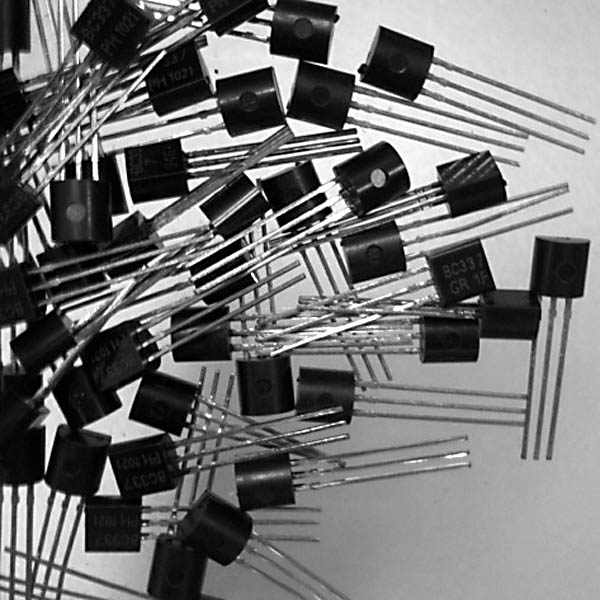
Compact, rugged little transistors, replacing the bulky and fragile vacuum tubes of old.(© All Rights Reserved)
Compact, rugged little transistors, replacing the bulky and fragile vacuum tubes of old.
(© All Rights Reserved)

The transistor was basically a much smaller and more usable replacement for the bulky vacuum tubes used before, and as such opened up many new possibilities in electronic component development. This lead to it being referred to as ‘the electronic engineer’s dream’.

At least their efforts didn’t go unnoticed – for their invention, Brattain and Bardeen shared the 1956 Nobel Price for Physics.

Albert Jones and the invention of corrugated cardboard

Our subject for today is corrugated cardboard.

It was on this day, 19 December* back in 1871 that New Yorker Albert Jones received the first US patent for corrugated paper board, which he proposed as a packing and shipping material. A similar form of paper corrugation had been patented years earlier, in 1856, in England, where it was used as a liner for tall hats, but Albert Jones’ patent was the first that specifically proposed it as an improved packing material.

Corrugated cardboard - simple and clever, like all the best inventions.(© All Rights Reserved)
Corrugated cardboard – simple and clever, like all the best inventions.
(© All Rights Reserved)

Jones’ original patent was for a single-face corrugation, that is, a sheet of corrugated paper lined on one side with flat cardboard paper. Oliver Long soon updated and expanded the Jones patent by patenting corrugation with lining on both sides – basically the standard cardboard packing box as we know it today.

It took a while for the concept to catch on, but by 1890 corrugated cardboard boxes were in general use. It was initially used for packaging breakable material like glass and pottery, and by the mid-20th century it had become cheap enough to be used for packing fruit and fresh produce, reducing the bruising of the fruit going from the farm to the market.

Eventually, corrugated cardboard has become so commonplace that it is pretty much ubiquitous as the preferred material for boxing and packing. In fact, it’s really hard to imagine a world without it, isn’t it?

*Some sources say the patent was issued on 20 December, but most seem to agree on 19 December being the correct date.

Celebrating Edwin Armstrong, the man who gave us FM radio

It’s the birthday today of American engineer and inventor Edwin Howard Armstrong (18 Dec 1890 – 1 Feb 1954). In case the name doesn’t ring a bell, he is the guy who laid the foundation for much of modern day radio and broadcasting electronics.

Among other things, Armstrong invented the continuous wave transmitter, the regenerative circuit and the superheterodyne receiver. He also invented frequency modulation (FM) radio transmission. Basically, radio electronics as we know it would not have existed if it wasn’t for his fundamental contributions to the field. Some commentators have gone so far as to call him “the most prolific and influential inventor in radio history”.

Modern electronics owe much to the genius of Edwin Armstrong.(© All Rights Reserved)
Modern electronics owe much to the genius of Edwin Armstrong.
(© All Rights Reserved)

Armstrong fought a long and frustrating battle with his former employer RCA over the invention of FM radio. RCA also claimed the invention, and won the patent battle for the technology. RCA’s ownership of the key FM patents meant that Armstrong could not claim any benefits from the widespread adoption of FM radio in the USA. This sad development left him emotionally broken and financially ruined and contributed to his suicide in 1954. What makes the story even more depressing is that Armstrong posthumously won most of his patent lawsuits against RCA, making him a very rich, dead man. His wife, Marion McInnis, used the money from the patents to establish the Armstrong Memorial Research Foundation, with which she was involved until her death in 1979.

It remains one of life’s cruel misfortunes that, as a result of corporate legal wrangles, a brilliant individual like Edwin Armstrong was never able during his lifetime to get the recognition he so richly deserved.

Sophus Lie and the secret mathematical code

Today we celebrate the birthday of one of the great names in mathematics, Norwegian Sophus Lie (17 Dec 1842 – 18 Feb 1899). Lie made fundamental contributions to the theories of algebraic invariants, continuous groups of transformations and differential equations. Two concepts, Lie groups and Lie algebras, have been named after him.

Beyond being a great mathematician, Lie was, for a short while, also mistakenly considered to be a great spy. He was in Paris during the outbreak of the 1870 French-German war, and decided to leave France for Italy. Before he made it to the Italian border, however, the French arrested him as a German spy.  Reason being, they found his mathematics notes, and thought these were secret, coded messages.

A stack of papers with weird notes and symbols - can you blame military security for thinking they just arrested a super spy!?(© All Rights Reserved)
A stack of papers with weird notes and symbols – can you blame military security for thinking they just arrested a super spy!?
(© All Rights Reserved)

It was only after the French mathematician, Gaston Darboux, intervened and confirmed that the notes was in fact legitimate mathematics, that Lie was released.

Based on this experience, Lie decided that perhaps it was safer to return home and continue his work in the Norwegian town of Christiania, where he had originally studied mathematics.

The moral of the story, I guess, is that if you plan on travelling through a war zone with your math notes, keep them plain and simple, or keep them very well hidden!

About clip-on ties, real ties and mathematics

Rumor has it that today, 84 years ago in 1928, some clever folk came up with the concept of the clip-on tie. You know, those ties that look like the real deal, but instead of being tied around your neck just consist of the hanging bit with a permanent knot at the top, which can be attached to your shirt via a little metal clip stuck to the back of the knot.

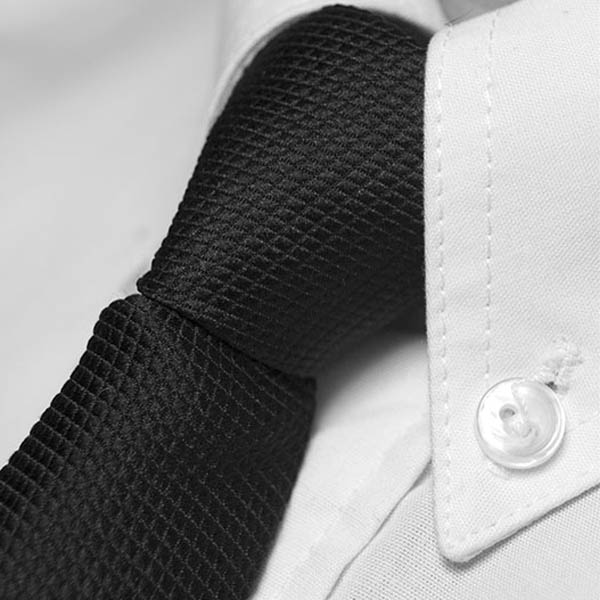
Try as you might, but a clip-on tie will never have the 'oomph' of a classy, properly tied tie.(© All Rights Reserved)
Try as you might, but a clip-on tie will never have the ‘oomph’ of a classy, properly tied tie.
(© All Rights Reserved)

I’m not sure if it was originally designed for people too lazy to tie a tie, or for people who had difficulty mastering the skill, but it proved to be quite a useful invention. Disabled people can use it without trouble. So can kids. Cops and security personnel wear clip-on ties as a safety precaution – it negates the potential risk of being strangled by your conventional necktie. Similarly, people in factory environments who wear ties are also advised to wear clip-ons – in the unfortunate event that the tie gets caught in a piece of machinery, it will simply clip off, rather than pulling its owner into the machine as well. (Then again, why people in factories would wear ties I have no idea.)

On the downside, clip-ons aren’t exactly haute couture – you are unlikely to get a designer-styled, silk clip-on tie. And a clip-on tie pretty much looks like a clip-on tie – the unique individuality of a slightly unsymmetrical knot is not an option. And of course you cannot go for the cool chic of the ‘loosened tie look’ with your clip-on tie – well, I guess you can clip it on to one side of your loosened collar, but somehow it just ain’t going to have the same effect!

So what does a clip-on tie have to do with science, you may ask? Well, very little, but it did bring to mind a mathematics book by Thomas Fink and Yong Mao, called ‘The 85 ways to tie a tie’ – a book where the authors use concepts from topology and a mathematical representation of knots to prove that a conventional neck tie can be tied in exactly 85 possible ways. The 85 ways are pretty theoretical – apparently only a dozen or so are sufficiently unique and handsome to be sensible candidates for an actual tie knot.

Yes, today is about ties, but as is often the case, the maths are lurking just below the surface!

Outer space … and the peaceful use thereof

I am sure more than enough blogs today will be denoted to the date 12-12-12, and the significance of this date in numerology, the Mayan calender and who knows what other esoteric contexts.

So, let me rather discuss another event celebrated today – on this day back in 1959, the United Nations Office for Outer Space Affairs set up it’s Committee on the Peaceful Uses of Outer Space, also known as COPUOS.

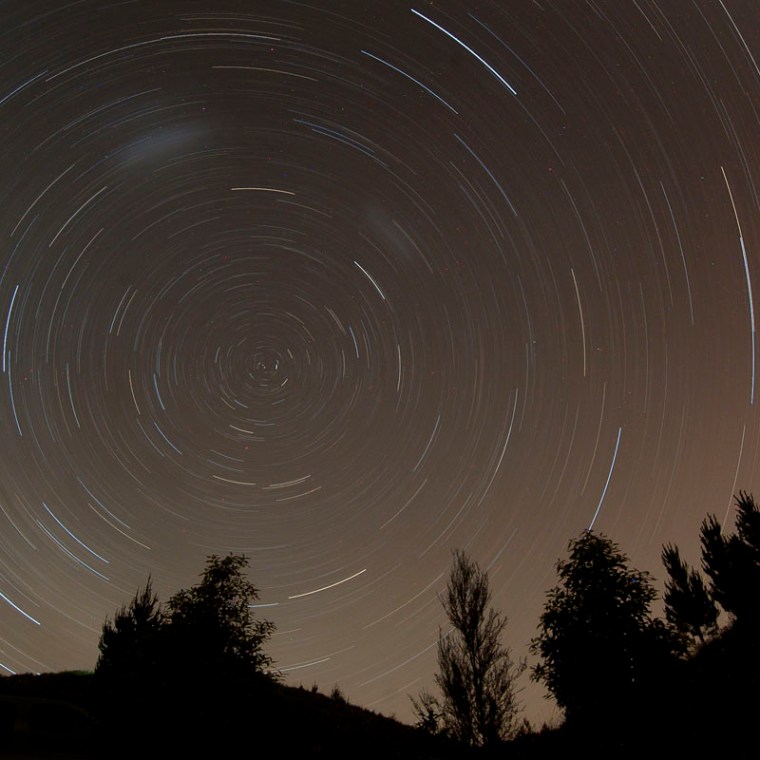
Space - a big topic for an UN subcommittee.(© All Rights Reserved)
Space – a big topic for an UN subcommittee.
(© All Rights Reserved)

The mandate of COPUOS is “to review the scope of international cooperation in peaceful uses of outer space, to devise programmes in this field to be undertaken under United Nations auspices, to encourage continued research and the dissemination of information on outer space matters, and to study legal problems arising from the exploration of outer space.”

While this may seem a bit ‘out there’ to most of us earth-bound human beings, it is quite an interesting concept, and I guess in a way nice that there is at least some body responsible for keeping human extraterrestrial activities in check – we all know what silly things us humans can do with new things and domains that we don’t yet fully comprehend, and where we don’t quite understand the potential consequences of our actions.

The idea for the committee came up shortly after the launch of the first artificial satellite in 1958, right at the time when human interest (among both the scientific community and the general public) in outer space started seriously picking up, and about a decade before the first moon landing. Starting with 24 members, the committee has since grown to 71 members, making it one of the largest committees in the UN. Personally, the mind boggles when I look at the member list – you have to ask yourself what some of these countries could possibly contribute to the discussion on outer space. But then again, it is surprising what some countries spend their national budgets on…

Actually, thinking about it, perhaps it’s not strange that COPUOS is such a big committee. Space is, after all, a pretty big topic.  In the words of Douglas Adams: “Space is big. You just won’t believe how vastly, hugely, mind-bogglingly big it is. I mean, you may think it’s a long way down the road to the drug store, but that’s just peanuts to space.”

Melvil Dewey and the classification of knowledge

Today is the birthday of Melvil Dewey, the American librarian and educator, and inventor of the Dewey Decimal System of library classification. In memory of Melvil Dewey, today is the Dewey Decimal System Day.

The Dewey Decimal System, or Dewey Decimal Classification (DDC) is a numerical system of library classification first proposed by Dewey in 1876. Since its inception, the classification has been revised and expanded through 23 editions, the latest issued in 2011. Basically the system provides a framework within which a library book is assigned a ‘DDC number’ that unambiguously locates it in a specific space of shelving in the library, making it easy to find and return to its proper place.

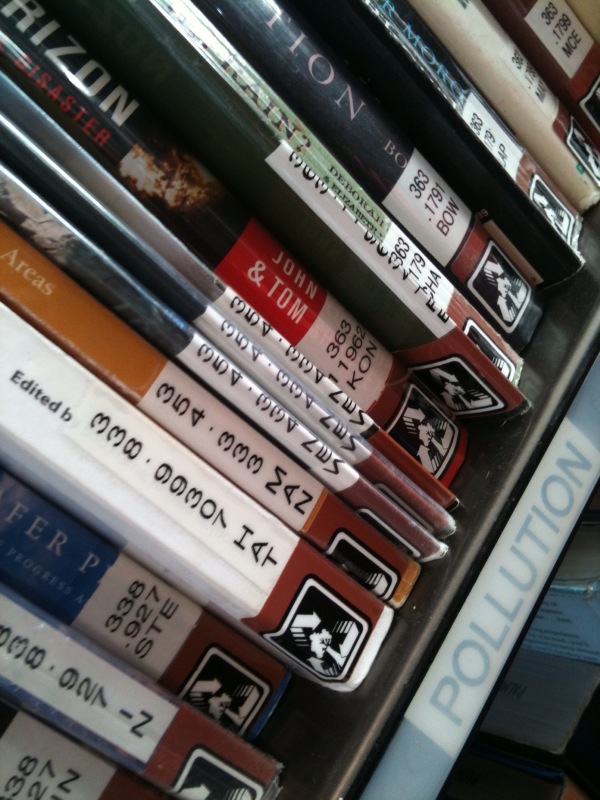
For every subject, there's a Dewey classification number - in this case, environmental pollution.(© All Rights Reserved)
For every subject, there’s a Dewey classification number – in this case, environmental pollution.
(© All Rights Reserved)

The Dewey system classifies all books into 10 basic categories:

  • 000 – Computer science, Library and Information science & general work
  • 100 – Philosophy and psychology
  • 200 – Religion
  • 300 – Social sciences
  • 400 – Language
  • 500 – Science
  • 600 – Technology
  • 700 – Arts
  • 800 – Literature
  • 900 – History, geography & biography

While fiction books can also fit into the Dewey system (in the 800s), most libraries reserve the system for non-fiction works, rather classifying fiction using a basic alphabetic author-based system.

The Dewey system is used by no less than 200 000 libraries in more than 135 countries. It’s main competitor is the American Library of Congress Classification, which is more complex, but does have the advantage that it allows for the addition of new categories, which makes it more future-proof. The Library of Congress Classification is, however, very US-centric, and despite its increased adaptability it has been much less widely adopted than the Dewey system.

To what extent Dewey’s Decimal System will be able to continue remaining relevant as the knowledge landscape changes remains to be seen, but there can be no doubt that Melvil Dewey made a huge contribution to the classification and accessibility of knowledge the world over. And that must be a good thing.


Libbie Hyman and the Invertebrates

Today we celebrate the birthday of Libbie Henrietta Hyman (6 Dec 1888 – 3 Aug 1969), the US zoologist who was responsible for one of the most important zoological reference works, ‘The Invertebrates’ – an amazingly comprehensive, 6 volume labour of love covering most phyla, and still used today. The sixth and final volume was completed at the age of seventy eight, by which time Hyman was suffering from Parkinson’s disease.

An earth worm, just one of many, many, many, many invertebrate animals.(© All Rights Reserved)
An earth worm, just one of many, many, many, many invertebrate animals.
(© All Rights Reserved)

What makes a reference work addressing the subject of invertebrates so daunting, is that something like 97% of all animal species fall in this category. Basically, invertebrates are all animal species that do not develop a vertebral column. Which means, it’s all animals except the vertebrates (reptiles, fish, amphibians, mammals and birds). Invertebrates include insects, worms, spiders, mollusks, sponges and more.

The classification of ‘Invertebrates’ is so wide that no single characteristic describes them all. While they all lack a vertebral column, they are otherwise very dissimilar, with widely varying body plans from fluid-filled hydrostatic skeletons (jellyfish, worms) to shell-like exoskeletons (insects, crustaceans).

Given this diversity, Libbie Hyman’s achievement of incorporating so many invertebrates into her six reference volumes seems even more impressive. She was certainly no spineless academic!