Page 12 of 18

Getting solarised on Man Ray’s birthday

Today we celebrate the birthday of one of the great avant-garde photographers of the modern era – the enigmatic Man Ray. Born Emmanual Radnitzky (27 Aug 1890 – 18 Nov 1976) in Pennsylvania, US, he was the oldest child of Russian Jewish immigrants.

He changed his named to Man Ray in his early 20’s – ‘Ray’, a shortened form of Radnitsky, was something his brother came up with in reaction to the anti-Semitism prevalent at the time, while ‘Man’ came from his childhood nickname ‘Manny’.

Interested in art from an early age, Man Ray pursued a career as an artist after leaving school. Starting with painting as his medium of choice, he soon developed an interest in the avant-garde movement and became involved with the Dadaists in New York. He started investigating alternative image-making methods, including photography, as well as experimenting with various new artistic forms and techniques, including readymades (influenced by his friend Marcel Duchamp) and kinetic art.

In 1921 he relocated to the Montparnasse quarter in Paris, France, an area favoured by artists of the time. Over the next 20 years, he focused on photography, becoming an influential photographic artist and photographing many of the key figures in the art world, from James Joyce to Jean Cocteau.

While he made a notable contribution as painter, he is perhaps best remembered for his photography – he is responsible for some of the most iconic photographic images of the 20th century. Together with his assistant and lover Lee Miller, herself a surrealist photographer of note, he ‘reinvented’ the technique of solarisation when Lee accidentally over-exposed an image in his darkroom.
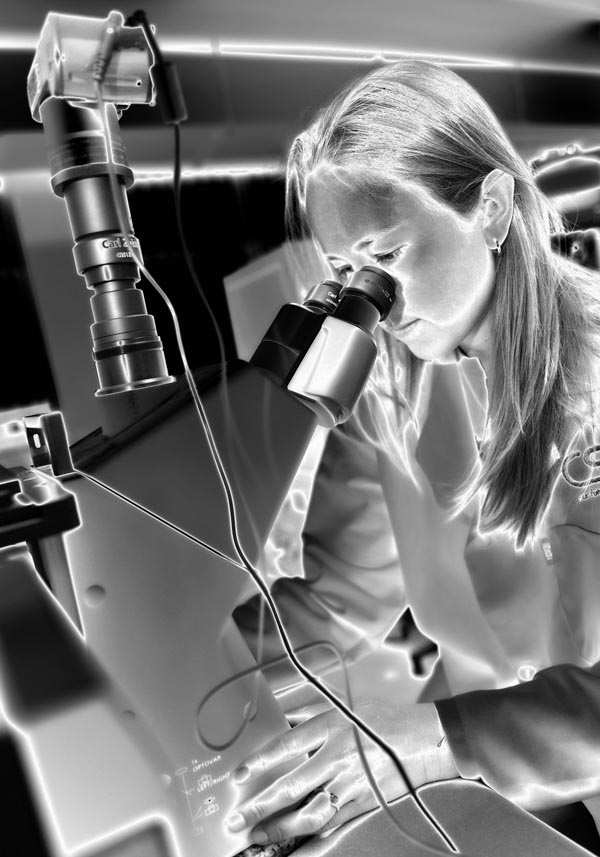
A digitally ‘solarised’ image. Given my science photography focus, I’ve opted for a scientific image to subject to the solarisation treatment.
(© All Rights Reserved)

Solarisation is the partial reversal of an image which occurs when a film or print is subjected to a brief period of extreme over-exposure. The effect was first discovered in the early 19th century and was already identified by photographic pioneers such as Daguerre and Draper, so Man Ray definitely didn’t invent the concept. He did, however, recognise the creative potential of this ‘accidental technique’, which usually occurs when a film or print is accidentally exposed to brief flash of light (like briefly switching on a light in the darkroom). He spent a lot of time and effort perfecting the technique, and produced some of the classic examples in this style.

While the solarisation technique is a physical, chemical process achieved during the development of a piece of photographic film or print, various digital processing techniques have been developed to mimic the solarisation effect – Adobe Photoshop even has a readymade ‘Solarize’ filter. A decent digital approximation of the solarisation effect can be achieved using tools like Photoshop, but it’s not quite the same as the real thing. It is definitely less exciting in the sense that you are almost in too much control of the effect – you can precisely control the levels of ‘digital solarisation’, unlike the physical situation where you are partially at the mercy of the chemistry of your medium, and the element of chance becomes an integral part of the artistic process.
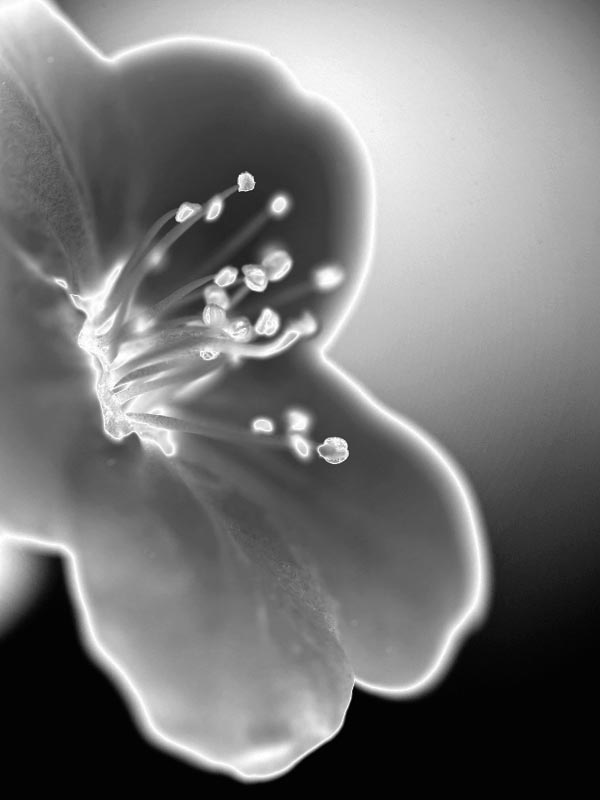
Flowers make excellent subjects for solarisation.
(© All Rights Reserved)

Of course art is not just about the tools – whether you use a flash of light or a photoshop tweak to achieve a creative result, the technique will always be subservient to the artistic inspiration. In the words of Man Ray himself:

“… there will always be those who look only at technique, who ask ‘how’, while others of a more curious nature will ask ‘why’. Personally, I have always preferred inspiration to information.”

The birth of Linux, giant killer of the Open Source world

A while ago, I published a post on the start of the open source operating system revolution. As mentioned there, Linus Torvalds did not ‘invent’ the open source operating system with Linux, but there’s no denying that he is one of the true superstars of the open source world, and that Linux is, without a doubt, one of the few open source operating systems that have managed to make the big commercial players sit up and take notice.

From cellphones to supercomputers – Linux is a popular operating system across a wide range of platforms.
(© All Rights Reserved)

There is some debate around the date that should be considered the ‘official’ birthday of Linux – there are three early emails from Torvalds making reference to his operating system – but the general consensus seems to be that his email of 25 August 1991 best represents Linux’s inception:

From:torvalds@klaava.Helsinki.FI (Linus Benedict Torvalds)
Newsgroup: comp.os.minix
Subject: What would you like to see most in minix?
Summary: small poll for my new operating system
Message-ID: 1991Aug25, 20578.9541@klaava.Helsinki.FI
Date: 25 Aug 91 20:57:08 GMT
Organization: University of Helsinki.

Hello everybody out there using minix-

I’m doing a (free) operating system (just a hobby, won’t be big and professional like gnu) for 386(486) AT clones. This has been brewing since april, and is starting to get ready. I’d like any feedback on things people like/dislike in minix; as my OS resembles it somewhat (same physical layout of the file-sytem due to practical reasons) among other things.

I’ve currently ported bash (1.08) an gcc (1.40), and things seem to work. This implies that i’ll get something practical within a few months, and I’d like to know what features most people want. Any suggestions are welcome, but I won’t promise I’ll implement them 🙂

Linus Torvalds torvalds@kruuna.helsinki.fi

Originally developed for Intel x86 personal computers, the Linux operating system has since been ported to a wider range of platforms than any other operating system, ranging from servers to supercomputers to embedded systems. The Android operating system, used by a wide range of mobile devices, is built on a Linux kernel. Quite amazing for a system that it’s creator described as “just a hobby, won’t be big and professional like gnu”.

The Linux story really is a feel-good tale of how a non-commercial product, based on a free and open community-based development model, can match and exceed its multi-million dollar commercial competition.

Happy birthday, Linux, and power to you, Linus Torvalds – may you long continue to steer the ship, and take others along on your quest for the open and the free.

Celebrating George Crum and the birth of the potato chip

I should start today’s post with a bit of a disclaimer – while this tale is told as the truth, the exact date details are difficult to confirm. However, most references I could find stated the date as 24 August 1853, so here goes.

On the above date, Railroad magnate Commadore Cornelius Vanderbilt went dining at the Moon Lake House, a restaurant in Saratoga Springs, New York. He ordered french fries, but found the fries he received too thick, bland and soggy, so he sent them back to the kitchen. George Crum, the chef at the Moon Lake House, wasn’t impressed by what he considered to be an overly fussy customer, so he went overboard to address his concerns – he sliced the fries paper-thin, fried them to a crisp and seasoned them with a generous helping of salt. Much to his amazement, Vanderbilt loved the the crispy chips, so much so that the restaurant decided to add them as a regular menu item, under the name ‘Saratoga Chips’.

A few years later, in 1860, chef Crum opened his own restaurant, and he took pride in serving his ‘signature dish’, placing potato chips in baskets on every table.

Crispy, crunchy potato chips – not the healthiest snack around, but we cannot seem to get enough of them.
(© All Rights Reserved)

Despite the popularity of Crum’s invention, no-one recognised it’s potential as a mass-produced, off-the-shelf snack – it remained a restaurant delicacy until 1926, when Mrs Scudder began mass-producing potato chips packaged in wax paper bags. In 1938, Herman Lay started producing Lay’s Potato Chips, the first successful national brand in the US.

The rest, as they say, is history – chips (or crisps, as the Brits like to call them) have taken over the world, with the global chip market in 2005 generating total revenues of more than US$16 billion. That’s more than a third of the total savoury snack market for the year.

Of course, being deep-fried and doused in salt, chips aren’t exactly a health snack. They have been identified as one of the leading contributors to long-term weight gain, as well as being linked to heart disease. In response to these issues, potato chips companies are investing huge amounts in research and development of new, more health-conscious products. Frito-Lay, for example, have reportedly invested more than $400 million in new product development, including techniques to reduce the salt content in Lay’s potato chips without compromising taste.

Now flavour is one thing, but did you know that the crunch produced when we bite into a chip, also plays a significant role in our perception of the snack? According to a New York Times article, a team of psychologists at Oxford University conducted an experiment where they equipped test subjects with sound-blocking headphones, and made them bite into potato chips in front of a microphone. In different test runs, using the exact same chips, the sound of the crunch was processed in different ways and passed back to the testers via the earphones. Taking their perception of the unaltered sound as the benchmark, they found that when the crunchy sound was amplified, testers considered the chips to taste fresher and crispier, while muting the crunch resulted in the same chips being rated as less crispy and stale.

Hmmm, all this talk about crunchy chips is making me hungry – I can definitely do with a bag of good old Salt & Vinegar chips right about now!

Chasing away the winter blues with a roisterous “Hoodie-Hoo!”

Today us folk in the Southern Hemisphere get our turn to celebrate ‘Hoodie-Hoo Day’ (about 6 months after the Northern Hemisphere version). So what is Hoodie-Hoo? Well, in a nutshell it’s the day where we should all go outside at noon, drink in the (hopefully) warming weather and at the top of our lungs yell “Hoodie-Hoo!!” to chase away the winter blues and to celebrate the fact that spring is on it’s way.

According to some sources, you can celebrate the day in even more authentic style by donning a funny or unusual hat while performing your celebratory shouting.

‘Southern Hemisphere Hoodie-Hoo Day’, and its companion ‘Northern Hemisphere Hoodie-Hoo-Day’ are two of 80-odd holidays dreamt up by the folks over at Wellcat.com, a herbal company who felt the world simply didn’t have enough holidays, and came up with a bunch of new ones under the moniker of “Wellcat Holidays”.

The reason I decided to feature this day is that it got me thinking about this amazing time of year, when the seasons almost imperceptibly start changing. It is more often than not still cold and miserable, but everyone knows it’s not quite winter anymore – animals stir from hibernation, trees start budding all over the place, flowers appear as if by magic and there really is a sense of anticipation in the air.

The fruit trees in our garden, including this plum, are all doing their blossomy version of the Hoodie-Hoo.
(© All Rights Reserved)

Ever wondered how plants know spring is approaching? In a New Yorker article I found, Dr Susan Pell from the Brooklyn Botanical Garden explains things very nicely. According to Dr Pell, “Why and how plants flower when they do is something that has puzzled botanists for centuries. We’ve come a long way, but there is still quite a bit about the signalling details that we don’t know. There are many factors involved, but given the right growing conditions (soil nutrients, water and sun exposure), day length and ambient temperature are the key factors.”

Various proteins in the plant (such as phytochrome and cryptochrome) can actually sense the relative lengths of the light and dark parts of the day. (This is an example of photoperiodism.) Furthermore plants also sense ambient temperature, with some plants requiring a cold snap before they will start flowering. Once the nights become short enough and the temperature reaches the right level, growth, and specifically flowering, is triggered in the plants. As far as temperature is concerned, plants tend to not be fooled by a single unexpected warm day, but rather react to a sustained warm period. If such a period occurs too early, it can trick the plant into flowering earlier than it is supposed to, which could expose the fresh growth to frost damage in a subsequent cold spell. The plant’s light and dark sensing abilities should keep this from happening, but particularly in cities with lots of artificial light, these sensors may be too confused to function correctly.

Dr Pell furthermore says, “The hypothetical protein that signals plants to bloom once the ideal conditions have arrived has long been called ‘florigen‘, but it is uncertain whether or not it has actually been identified.” Claims to its identification has been made in various research papers, but no conclusive evidence have been presented.

I sometimes wonder whether us humans also have our own florigen-like trigger telling us that spring is on its way? One definitely gets a sense that the seasons are changing – this sense of new life stirring – even before you see spring flowers appearing. The world not only looks different (subtle changes in the colours of the sky and the land), but it also feels different – an early morning jog is still nippy as hell, but the cold somehow starts to feel refreshing, rather than depressing.

I don’t know – perhaps its merely the fact that my diary tells me spring is on its way that makes me see and feel things.  Whatever the case may be, and whether it’s florigen induced or not, I am definitely going to let rip with a loud ‘Hoodie-Hoo’ holler today!

(And to all my Northern Hemisphere friends – hang in there, and mark 20 February in next year’s diary. It may still be six months off, but your chance to ‘Hoodie-Hoo!’ is coming – better start practicing!)

Poet’s Day, mathematically speaking

Today is Poet’s Day, a day to celebrate the sensitive souls who, through the ages, shared their deepest thoughts through verse and rhyme. I have to admit to being more of a ‘prose person’ than a ‘poetry person’, but that by no means implies that I don’t have the greatest respect and admiration for a good poem – it’s simply not my very favourite literary form.

Of course there’s a close relation between poetry and mathematics – a subject that is close to my heart. It was Einstein who said: “Pure mathematics is, in its way, the poetry of logical ideas.”

Mathematics in general seem to play an important role in poetry. Not only is there mathematics in the structure and rhythm of poetry, but many poems have also been written that contain overt mathematical themes. In a 2010 article entitled Poetry Inspired by Mathematics, Sara Glaz from the University of Connecticut, discusses some examples of such poems. More examples can be found in an earlier article from 2006 by JoAnne Growney, Mathematics in Poetry. In the latter article, Growney elegantly states, “As mathematicians smile with delight at an elegant proof, others may be enchanted by the grace of a poem. An idea or an image expressed in just the right language–so that it could not be said better–is a treasure to which readers return.”

The wonderful Fibonacci number sequence not only pops out in nature, but now claims its place in the world of the poet as well.
(© All Rights Reserved)

An interesting new poetic form which I’ve discovered while doing some background reading for today, is the so-called “Fibonacci poetry”, which is based on the Fibonacci number sequence. Fibonacci numbers are a sequence, starting with 0 and 1, where each subsequent number is the sum of the previous two, i.e. 0,1,1,2,3,5,8,13,21,34,…

Fibonacci numbers occur often in nature, as I’ve discussed in an earlier blog post.

In poetry, the number sequence can refer to the numbers of letters, syllables or words in successive lines of the poem. These poems, known as ‘Fibs’, are six lines long, typically starting with a single letter/syllable/word in the first line. They can, however, theoretically start with any number of letters/syllables/words in the Fibonacci sequence.

Even though this form, originally introduced by Gregory K in a blog post on the GottaBook blog, appears to still be more popular among mathematicians than among poets, it has managed to garner a mention in the New York Times Books section. Their example, based on syllables, neatly illustrate the concept:

Blogs 
spread 
gossip 
and rumor 
But how about a 
Rare, geeky form of poetry?

I like the idea, I really do – very cool indeed! So, without further ado, herewith my own humble Fib for the day:

Words
and
numbers
sequences
not just in nature
but warming the hearts of poets too.

(uhm, assuming ‘poets’ is a single syllable word, of course…)

Happy Poet’s Day, everyone!  And please do share some Fibs, if you’re that way inclined!

Peristaltic pumps and artificial hearts

A hearty good day to everyone, and welcome to the new week. And yes, today ‘hearty’ is indeed the operational word, as this seems to have been an important day in history as far as the heart is concerned.

The heart, symbol of life and love.
(© All Rights Reserved)

Heart pump

Today we celebrate the birthday of Jerome Murray (20 Aug 1912 – 7 Jan 1998), an American inventor who invented the peristaltic pump that made open-heart surgery possible. The pump was unique in that it was able to pump blood without damaging the human cells, through a method of expansion and contraction that imitates the peristaltic process.

Artificial heart

Exactly 10 years after Murray’s birth, the Japanese surgeon Akutsu Tetsuzo (20 Aug 1922 – 9 Aug 2007), was born. Tetsuzo was the surgeon who built the first artificial heart that was successfully implanted into an animal. The heart that Tetsuzo developed was implanted into a dog on 12 Dec 1957, and kept the dog alive for about an hour and a half. While this may not be very long, it did open the door to further research into the domain, eventually leading to the succesful development of artificial hearts for humans.

So, even though today is not officially a heart holiday, it is clearly quite an important day in the history of the heart, and particularly the research and development of artificial technologies to support the human heart.

Spare a thought for your heart – it’s an amazing organ, and everyone who can live out their lives with their own, healthy hearts should count themselves really lucky. If something does go wrong, however, at least it’s good to know that there are clever people like Jerome Murray and Akutsu Tetsuzo in the world, who consider it their lives’ task to develop the incredible technologies that help keep us ticking along.

Vibrating strings and infinite series

Time to dive into some mathematics again – today we celebrate the birth of British mathematician Brook Taylor (18 Aug 1685 – 29 Dec 1731).

Taylor is best known for ‘Taylor’s Theorem’ and the ‘Taylor series’, a mathematical method for expanding functions into infinite series. In 1715, he published a groundbreaking work Methodus Incrementorum Directa et Inversa, which introduced a new branch of mathematics that became known as the ‘calculus of finite differences’.

Using finite differences, Taylor was able to mathematically express the movement of a vibrating string, reduced to mechanical principles.

The above work also contained what became known as Taylor’s Theorem – this blog is neither the time or place to even try and go into the details of the theorem, but suffice to say it is a pretty significant mathematical construct. Despite being introduced in his 1715 publication, it wasn’t until almost 60 years later that it’s value was fully recognised – in 1772 the great mathematician Joseph-Louis Lagrange termed it ‘the main foundation of differential calculus’.

Taylor employed the calculus of finite differences to mathematically express the movement of a vibrating string.
(© All Rights Reserved)

Besides being one of the great mathematicians of all time, Brook Taylor was also a keen artist, with one of his particular interests being the principles of perspective – he wrote an essay called “Linear Perspective” on this subject, which also included the first general introduction of the concept of vanishing points.

So to celebrate this day, how about strumming a guitar while staring off into the vanishing distance… or painting perspectives while listening to some soothing guitar (the Majestic Silver Strings, perhaps)… 🙂

Sounds like a good day to me!

Read my lips – the invention of non-smear lipstick

Today we’re discussing a subject that’s on many women’s lips – we’re celebrating the birth of Hazel Bishop (17 Aug 1906 – 5 Dec 1998), an American chemist, cosmetic executive, and the inventor of non-smear lipstick.

The saying goes that “gentlemen prefer blondes”, but research shows that if her lipstick is red enough, he may not notice her hair.
(© All Rights Reserved)

While the impact of this invention on the progress of humankind may be limited, it certainly left an indelible mark on the cosmetics industry.

Interestingly, it is said that Ms Bishop got the idea while working as an organic chemist for Standard Oil Development Company, after discovering the cause of deposits affecting superchargers of aircraft engines. She set about on a quest of relentless experimenting with various mixtures of staining dyes, oils, and molten wax until, in 1949, she perfected a lipstick that stayed on the lips better than any existing product available at the time.

Knowing she had a winner on her hands, she founded a cosmetics company, Hazel Bishop, Inc, manufacturing non-smear lipstick which was introduced to the public at $1 per tube. It proved a runaway success, with her company’s lipstick sales skyrocketing from $50 thousand in 1950 to $10 million in 1953.

Sadly, she lost control of the company in 1954 after a proxy fight with her stockholders. Not allowing this to get her down, she went on to start a research laboratory, became a stockbroker specialising in cosmetics stocks, and finally, in 1978, a professor at a fashion institute.

The story of lipstick is an interesting one. It’s use dates back to ancient times, with some very, uhm… interesting ingredients used. Ancient Egyptions used a mix of sea-based algae, iodine and bromine, while Cleopatra preferred the hue she got from the deep red pigment in crushed carmine beetles, with crushed ants used as a base. Over the years, ingredients used in lipstick have included beeswax, plant-based stains, fish scales (for a shimmering effect), deer tallow, and castor oil, to name just a few.

Through the ages, the use and acceptability of lipstick varied – in certain eras it was associated with high class and royalty, while other times saw its use confined to actors and prostitutes. Since the early 20th century, however, its use has become generally acceptable among all levels of society.

In a recent research project, studying men’s responses to women in the first 10 seconds after seeing them for the first time, researchers found that men are drawn to the lips more than any other facial feature. The extent to which the lips dominated their attention depended quite strongly on the use of lipstick.

In the case of a woman wearing prominent lipstick, men’s eyes would be fixated on the lips for between 6.7 seconds (pink lipstick) and 7.3 seconds (red lipstick) out of the first 10 seconds – less than one second was spent looking at her eyes, and even less studying her hair. Without make-up, men still paid attention to the lips, but in this case things were more balanced, with the gaze being shared almost equally between the lips, the eyes and the rest of the face.

It was found that men also preferred fuller lips, but the appeal of thin lips increased by 40% once lipstick had been applied.

It seems to me that the simplest solution to hiding any facial flaws is simply an abundant splash of red lipstick – men at least would seem unlikely to look at anything else. However, for women who consider their eyes and the rest of their faces worth looking at may want to hold back on the lipstick!

I cannot help but wonder whether the study focussed on only the first 10 seconds of the men’s gaze, because after this their attention moved to other parts of the anatomy? Perhaps that’s a topic for further research…

Relaxation Day and the world’s most relaxing room

Feeling a bit rushed and stressed out? Modern life getting the better of you? Then today is especially for you – August 15th is Relaxation Day.

Chilling out on Relaxation Day.
(© All Rights Reserved)

Some years ago, researchers at the University of Hertfordshire’s Health and Human Sciences Research Institute, led by Professor Richard Wiseman, did a study examining walking speeds around the world, and found that people’s lives are becoming ever more stressful and hurried. I am sure that comes as no surprise to anyone – we are all way too familiar with the stresses of modern life, with its ever increasing responsibilities, information overload, and the like. Less and less time for sauntering, it seems.

Anyway, what is interesting about this story is what Professor Wiseman and his team did next – they went on to develop what they consider to be, scientifically speaking, the world’s most relaxing room.

Opened to the public at a 2008 Showcase held by the University of Hertfordshire, the room consisted of soft matting on which you could lie back, with your head resting on a lavender-scented pillow. The room was furthermore bathed in ‘calming glade-like green light’, with a ‘completely clear artificial blue sky’ overhead. A specifically composed soundtrack was played – ‘music with a slow and distinct rhythm, low frequency notes, and no sudden changes in tempo’, also featuring a solo soprano voice, ‘chosen for the soothing properties of the human voice’, a ‘Tibetan singing bowl, used in meditation’ and a string ensemble.

All the features in the room were specifically selected based on scientific knowledge related to stress and relaxation. A subdued green light, for example, is supposed to enhance the production of dopamine in the brain, which has a calming effect, and the completely clear blue sky creates a ‘mild sense of sensory deprivation’ that helps you turn your attention inward and away from daily stresses.

Interesting concept, but to be honest, my idea of the ultimate relaxation space would rather be a grassy hill in the mountains, where I can lie back, out of cellphone contact, with cloudy skies overhead and no sounds other than a stream trickling in the background and the occasional bird chirping. And if this moment can happen after a day of hard walking or running in the mountains, even better. I bet it will beat the world’s most relaxing room any day…

Bliss… And very necessary!  I think I need to start planning that getaway weekend pronto.

I am curious – what would your ‘ultimate relaxation space’ look like?

Celebrating World Lizard Day – prehistoric looks and surreal abilities

Today we celebrate World Lizard Day. Yes, you read correctly – it seems there actually is such a day! Then again, if there’s a World Snake Day, why shouldn’t there be a World Lizard Day?

While there is a huge variety of lizards in the world (more than 5600 species, I believe) we only have a small subset of geckos and skinks down here in New Zealand – some 60 species in total. Well, at least we have some, unlike snakes, which we don’t have at all.

African wire-art lizard. Lizards are often depicted in African and South American art.
(© All Rights Reserved)

Lizards are a strange bunch. Even though many of them (like the bearded dragon) look really scary, they’re mostly harmless to humans. Except for the Komodo Dragon, of course. Growing to sizes in excess of 3m, they’ve been known to stalk and attack humans – definitely a thought that could give me some sleepless nights.

The more I learn about lizards, the more surreal I find them. And it’s not just their prehistoric looks – they are blessed with some decidedly odd skills too.

Some lizards, like the chameleon, can change colour. While it is to some extent done for camouflage, the main purpose of this is actually to signal its physiological condition and intentions to other lizards – they can for example show brighter, more aggressive colours when angered, while displaying lighter, multi-coloured patterns when courting. This colour-changing is done using specialised cells called chromatophores, containing pigments in their cytoplasm which can be voluntarily set to different intensities by the chameleon.

Chameleons can also use their tongues to reel in food from a distance of more than two and a half times their body length, by shooting their tongues out of their mouths at high speed. They can do this because their tongues are equipped with powerful, super-contracting muscles that are unique among back-boned animals. The tip of the tongue is covered in thick mucus that sticks to the prey and allows the chameleon to pull its food straight into it’s mouth. Quite useful for a quick take-away snack!

Equally strange, when you think about it, is the fact that many lizards can voluntarily sever their tails when facing danger – an act known as autotomy (from the Greek auto = “self-” and tomy = “severing”) or self-amputation. Even after it has been severed, the tail continues to wriggle, distracting the lizard’s attacker. Amazingly, the lizard can partially regenerate it’s tail over a period of a few weeks (even though the new tail will contain cartilage rather than bone, and may be a different colour to the rest of it’s body).

Even more surreal – and this really gets me – when threatened, some species of horned lizard can actually squirt blood from their eyes! This action, called autohaemorrhaging, not only confuses predators, but the blood also tastes bad thanks to the chemicals it contains. The squirting is done by restricting the blood flow away from the head, so blood pressure inside the head increases, rupturing tiny blood vessels in the sinuses near the eyelids. This bizzare act can be repeated several times, and the blood can be squirted a distance of more than 4 feet.

Honestly, a prehistoric-looking, blood-squirting, self-amputating, colour changing creature with a tongue twice it’s body length – I wouldn’t be able to make that up even if I wanted to! Surely the stuff of science fiction fantasy, and more than worthy of a special day of celebration.