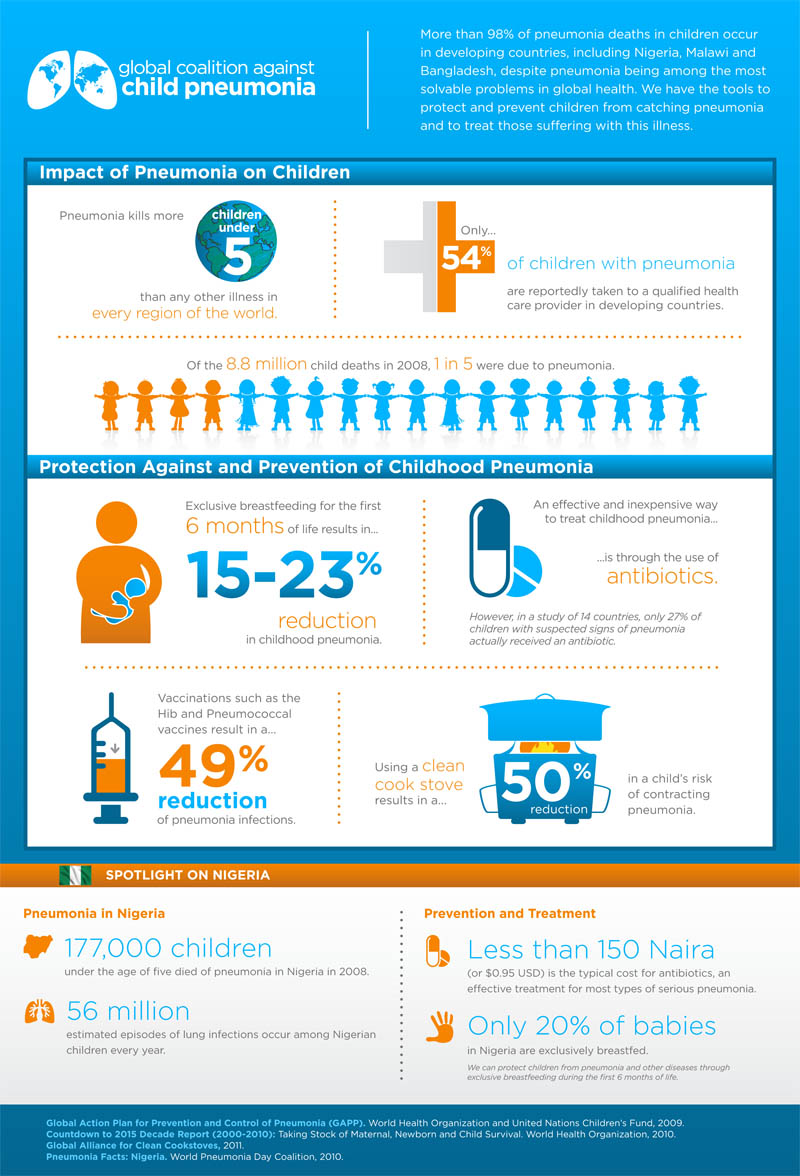
On this day, 12 November, we commemorate World Pneumonia Day. This day, established in 2009, is aimed at raising awareness about pneumonia, promoting interventions for protection, prevention and treatment, and generating action to combat pneumonia.
It is a sobering fact that, to this day, pneumonia remains the number 1 killer of children under the age of 5, responsible for more than 18% of all deaths in this age category. With some basic interventions, pneumonia can be largely prevented, and yet a child still dies from the infection every 20 seconds. The vast majority of these deaths occur in the developing world, where access to basic health care is severely limited, and out of reach for most children.
To facilitate knowledge sharing, the following infographic has been made available by the Global Coalition Against Childhood Pneumonia. Sharing is encouraged, so feel free to share it on Facebook or Twitter here.
Today, 11 November, is World Run Day. Nothing fancy, just a day founded first and foremost to celebrate the joy of running, and secondly to create an opportunity for runners to organise their own local World Run Day events, with the aim of collecting funds for a charity of their choice.
I love running. Simple as that. To me, running, and distance running in particular, really is the purest sport of all – no fancy equipment, no complicated rules, just you and the road. Be it a tarred road in a city or a dirt track in the mountains, the idea is to get from point A to point B using no other means of propulsion than your own body, sometimes with a specific target time in mind, and other times with no goal other than to have as much fun as possible while you’re out doing it.
The benefits of running are numerous – from a physical point of view, it has huge cardiovascular benefits, and despite the stories about ‘runner’s knee’ etc, it really is good for your musculoskeletal system. And the benefits are not just physical – few things clear the mind and calm the soul like a long run in the early morning before the city wakes up and all the craziness starts. Not to mention the mental boost of jogging on a beautiful single track path in the wilderness. And as any runner will tell you, few things beat the ‘runner’s high’ you get after a long, tough run.
Before I ‘became a runner’ (I still often doubt if I can call myself that, especially when I see these huge gaps in my running diary, but that’s another story…) I remember seeing these people seemingly slogging along on the pavement, often in terrible weather, and I thought to myself they must be crazy. Why on earth would you do this to yourself? And it looks so boring! And then, one day, for whatever reason, you decide to go for a jog; and then another; and then perhaps you enter some fun run… And so it evolves, and before you know it, you’ve finished your first marathon. Or perhaps you never bother entering a race, and simply get into the habit of going out for a run every day, some rain or shine. But suddenly things are different – you’re the one out running in the rain, and seeing these people driving past, looking at you like you’re some crazy nut.
But you know better…
Join me in celebrating World Run Day. Go for a run. Whether you’ve done it before, or not. Whatever the weather.
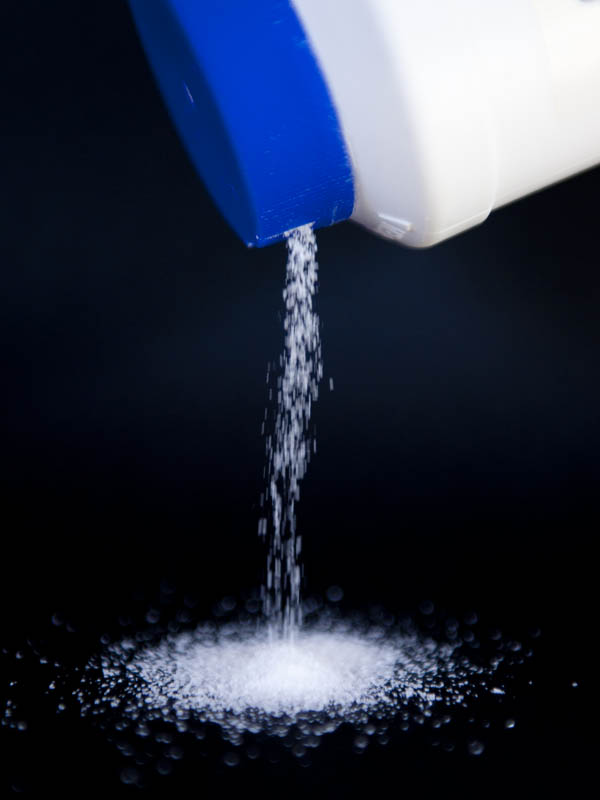
Our subject for today is table salt, or more specifically, iodised table salt. We are commemorating the work of David Marine, an American pathologist who died on this day back in 1976.
Marine did research on the treatment of goiter (swelling of the thyroid gland in the neck) with iodine. Between 1917 and 1922 he ran medical trials on a large sample of school girls, showing that iodine supplementation significantly reduced the incidence of goiter. Recognising the potential health benefits of iodine supplementation, Marine worked on the World Health Organisation’s salt iodisation programme.
Adding trace amounts of various iodine salts to regular table salt is an easy and effective way of preventing iodine deficiency in people. Worldwide, iodine deficiency is said to affect almost 2 billion people, causing mental retardation and various thyroid problems including goiter. While people in some regions, for example near the coast, can potentially get enough iodine from their general diet, the majority of the world has low natural iodine levels, resulting in the need for artificial supplementation.
Over the years there has been some opposition to iodisation of salt, mainly from fringe groups such as small salt producers concerned about the added production expense, manufacturers of iodine supplements who are obviously at risk of losing their market, and health groups concerned that the promotion of iodised salt will lead to excessive salt intake. Of course there will always be lobbies (rightly) promoting foods and food products that are as ‘natural’ and ‘pure’ as possible, and who would prefer to rather get their iodine in some more natural way. For this reason, most countries allow both iodised and non-iodised salt to be sold to consumers.
While the iodisation of salt has contributed a great deal to improve global iodine deficiency levels, there are indications in many countries, including new Zealand, of a re-emergence of iodine deficiency. This is due in part to the increased consumption of commercially prepared foods made with cheaper, non-iodised salt, and because of decreased general use of salt (iodised and not) as a response to health programmes recommending reduced salt intake.
Of course using less salt, iodised or not, is a good thing, as we discussed previously. But the key message from most health bodies, in terms of iodine intake, is to opt for iodised salt when we do use salt, and to generally give preference to freshly prepared, non-processed foods. Non-vegetarians can boost their iodine intake with iodine rich foodsources like seafood, milk, eggs and meat, but vegetarians may well consider an iodine supplement.
Just remember that the iodine in iodised salt disappears over time due to evaporation and oxidation, so even when you do use iodised salt, that bag of salt that’s been sitting in the cupboard for years may not be of much use as an iodine supplement anymore.
It’s the 1st of November, and summer is well and truly upon us here in the far South. Being November, of course it also means this is Movember – the one month men around the world become heroes for sporting facial hair that would, during any other month, raise serious questions about their state of mind.
Floppy, curly, twisty, bushy, or perfectly groomed, Movember is the month for crafting your own unique moustache – as individual as your fingerprints.
The reason of growing a ‘mo’ during Movember is to help raise awareness about men’s health, specifically prostate cancer and depression. As stated on the Movember site, “Mo Bros effectively become walking, talking billboards for the 30 days of November and through their actions and words raise awareness by prompting private and public conversation around the often ignored issue of men’s health.”
Movember started in Australia (good on ya, mate!), and has since grown into a truly global movement, with almost 2 million participants in a wide range of countries, including Australia, New Zealand, the US, Canada, the UK, South Africa, Ireland, Finland, the Netherlands, Spain, Denmark, Norway, Belgium and the Czech Republic. Movember aims to “change established habits and attitudes men have about their health, to educate men about the health risks they face, and to act on that knowledge, thereby increasing the chances of early detection, diagnosis and effective treatment.”
You can get involved informally, simply by not shaving your moustache for a month. However, to really go the whole nine yards, why not register through your national Movember website/forum, where you can formally commit to the challenge, and update your progress throughout the month. Different countries have their own unique sites, typically http://<your country code>.movember.com/ (simply going to www.movember.com should also redirect to your local site). Committing on such a public forum not only helps to keep you honest (to keep you from shaving your mo for that special date or meeting halfway through the month) but it also means that you officially become part of the Movember fundraising initiative. And, most importantly, you become a registered Mo Bro, part of the global Mo Brotherhood.
Of course it’s not just for men – women are also encouraged to register as ‘Mo Sistas’, in support of the men in their lives.
To visit me, Mo Bro Gerry, drop by my Mo Space Page – I will try to update the space every so often and will also be posting updates on this blog, so let this serve as an early dubious facial hair alert.
It’s Monday, the start of yet another busy week. Today, as we speed towards the end of the year at an ever increasing speed, rushing to get everything done in our ever-busier lives, we celebrate a special day that may be just what the doctor ordered – today is Hermit Day.
A hermit, according to the Free Dictionary, is “a person who has withdrawn from society and lives a solitary existence; a recluse.” While the concept of a hermit traditionally has religious connotations, and is specifically associated with people who choose to live a life of ascetic seclusion out of religious conviction, it can also be more generally applied. As stated in Wikipedia, “In modern colloquial usage, the term ‘hermit’ denotes anyone living a life apart from the rest of society, or who simply does not participate in social events as much as is common, regardless of their motivation in doing so, including the misanthrope.”
So, today is the day to shun all those tiring social responsibilities and to spend some me-time. Stay inside, or if the weather is good, spend some alone time in the garden, or go walk a secluded trail. Heck, stay in bed if you you feel that’s what you need. Unplug the phone, switch off the mobile, just avoid all social contact for a day.
OK, in this age of connectedness you may need a slightly earlier warning to plan for a day of total seclusion, but even if you cannot spend the entire day by yourself, try to at least spend some alone-time to recharge your batteries. And maybe make a concerted effort to plan your own personal hermit day for some other time – it can do you a world of good.
In a 2011 Boston Globe article called The Power of Lonely, it is reported that, despite the oft publicized benefits of social concepts like collaborative innovation, group-therapy, social support structures etc, there is an emerging body of research suggesting that some seclusion and alone-time can be very beneficial. The article (a good read, by the way) lists research hinting at the positive impact that alone-time can have on memory recall and creative thinking. It is also suggested that spending time by ourselves improves our subsequent interactions with others when we have to return to more social activities.
An important factor differentiating between solitude being a positive or negative experience, is whether that solitude is by choice. When we choose to spend some time alone, the time can be beneficial on many levels. If, on the other hand, we are isolated or secluded against our will, the association tends to be much more negative and can be a rather harmful experience.
Perhaps one of the best quotes on the value of voluntary seclusion comes from the great scientist and inventor Nikola Tesla, who once said “The mind is sharper and keener in seclusion and uninterrupted solitude. Originality thrives in seclusion free of outside influences beating upon us to cripple the creative mind. Be alone—that is the secret of invention: be alone. That is when ideas are born.”
Today, 28 October, is Wild Foods Day, a day to celebrate edible wild plants. Wild-growing fruits and vegetables have through the ages been a key food source for many people, and these foods are now starting to get their time to shine, with more and more gourmet chefs introducing unique twists on their menus through the incorporation of wild fruits, root crops etc.
Being unprocessed and thus free from pesticides and other interventions, wild fruits and vegetables are also an eco-friendly choice, and many argue that fruits and veges grown without intervention has an intensity of flavour not found in more cultivated varieties – hence the wonderful wine made from free-growing bushvine grapes, for example.
On this day, you are encouraged to learn about, and find, wild fruits that grow in your area. It is amazing how much edible stuff there is freely available around us if we just know what to look for – from herbs to edible flowers and leaves to all kinds of berries and other fruits. Just remember that not all pleasant-looking berries etc are edible – some will leave you with a pretty sore tummy, or much worse. It is definitely recommended that you do your homework before setting off to ‘live off the land’!
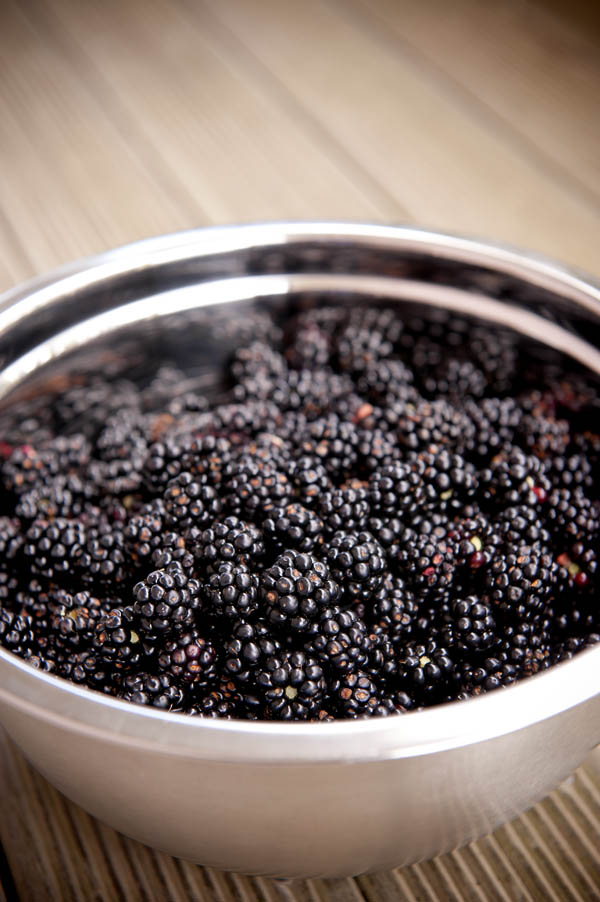
On the section of land where we live, we have a huge crop of wild blackberries growing freely against a hill. While the aggressively spreading plants can be a pest most of the year, berry season is a exciting, fun, thorny time – you have to be very careful to avoid some rather painful stings from the thorny bramble shoots when harvesting the intensely sour-sweet black fruit. The thorns are definitely not enough to deter the children of the area, hence the common sight during this time of year of kids walking around with reddish-black stained faces and hands.
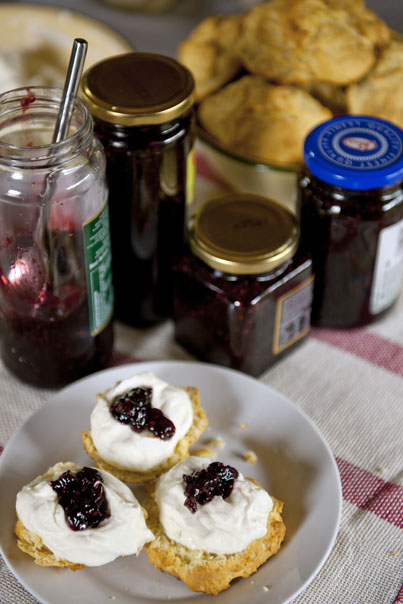
While these berries are great to eat as is, their abundance mean that you’re better off processing some for later use. A personal favourite solution to this ‘problem’ is blackberry jam – an absolute winner served with cream on a homemade scone.
Do you have any interesting wild food growing where you live? Have you eaten it, or processed it for later consumption? Any interesting tales to share?
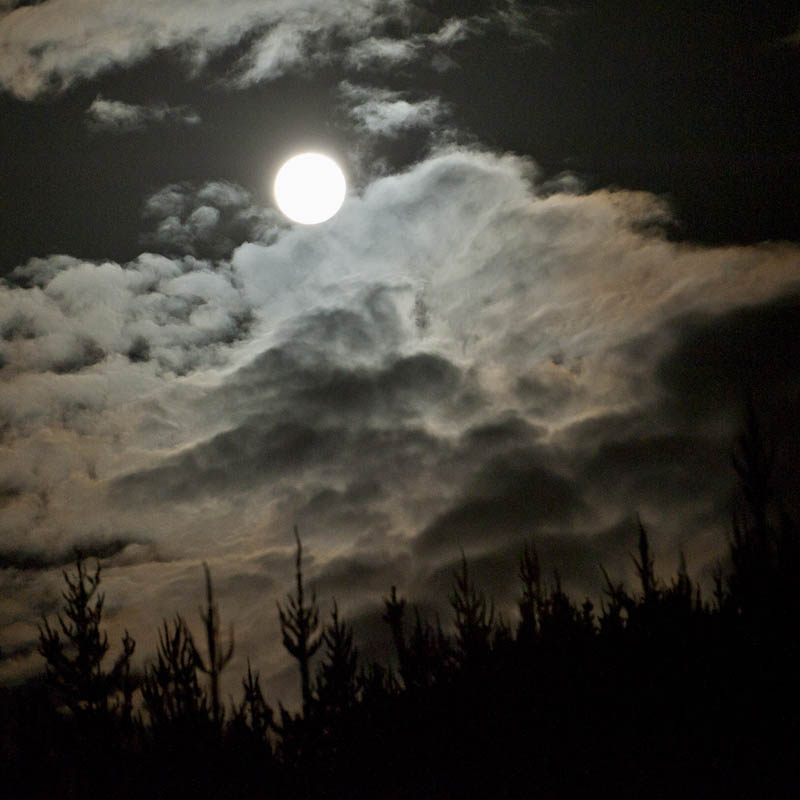
Today is the last Friday in October, the last Friday before Halloween, which means tonight is Howl at the Moon Night. If you’re a fan of Twilight, or any of the vampire franchises, this may be old news to you, and you’ll be all excited and prepared for this night already. On the other hand, if (like me), the whole vampire scene fails to move you, you can always take this opportunity to get rid of some pent-up frustration by indulging in a good holler once the moon appears over the horizon. I’m not suggesting the whole primal therapy trip that was so popular in the early 70s – all I’m saying is that a good yell, howl, holler or scream can do wonders for your stress levels, and if there’s a day (or night) giving you the perfect opportunity to let it rip, why not?
Of course, unless you work the night shift, you’re unlikely to be at work when the yelling starts. Which is a pity, given that a study reported in The Independent indicates that freely expressing anger in the workplace is a good way of keeping your heart healthy. Apparently, people who suffer in silence after unfair treatment at work have twice the risk of dying from heart disease compared to those who vent their anger. Researchers from the University of Stockholm followed 2755 male workers for a period of 13 years, from 1990 to 2003, measuring their blood pressure, body mass index and cholesterol levels, and related this to their coping mechanisms at work. After correcting for biological factors, they found those who bottled up their anger had higher blood pressure and were twice as likely to suffer from heart disease. Studies on women showed similar trends, though not as pronounced as their male counterparts.
The value of a good yell is widely acknowledged. American psychiatrist Dr Peter Calafiura says that yelling can have a positive mental influence. It triggers endorphins, resulting in a natural high, and a generally good feeling. This is very similar to the well-known runner’s high, so perhaps today is a good day to skip your post-work run and rather have a howl at the moon – it should result in an equally good mood!
Fettuccine, ravioli, lasagne, tortellini, cannelloni, spaghetti, macaroni… If (like me) the mere mention of these words make your mouth water, you’ll be happy to know that today, 25 October, is World Pasta Day.
“Account was taken and stress was laid on the importance of spreading to the utmost the knowledge of pasta among consumers throughout the world by means of collective initiatives of promotional nature and institutional information campaigns.
The countries with greatest experience in this field made available their know-how for the benefit of those countries which have only recently come to realise the virtues and merits of pasta.”
It all sounds terribly formal, but basically the idea of the day is to organise annual events around the world to promote the benefits of pasta and show that it is “appropriate for a dynamic and healthy life style capable of meeting both primary food requirements and those of high-level gastronomy.”
I’m all for it, of course. If I had pick a favourite category of food, pasta would definitely be at or near the top. Its versatility makes it ideal for everything from a quick snack to a hearty home meal to a gastronomic feast. And I know many people share this passion – quite amazing for a simple dough made from only flour and egg. But of course the magic doesn’t lie in the pasta itself, but in the way it serves as the perfect base for anything from a basic sauce or pesto to a mouthwatering combination of vegetables, meats or seafood.
And the best part of it is that pasta can be enjoyed as part of a healthy diet. Pasta is a good source of complex carbohydrates, low in sodium, cholesterol free and (in the case of whole wheat pasta) a good source of fibre. And of course it works well with other healthy foods – to quote the Pasta Fits website, it is the perfect partner for “fiber-filled vegetables and beans, heart-healthy fish and vegetable oils, antioxidant-rich tomato sauce and protein-packed cheese, poultry and lean meats.”
While pasta may be traditionally Italian cuisine, the rest of the world has certainly caught on to its appeal. The Italians still eat by far the most pasta (26 kg per capita per year, according the the International Pasta Organisation’s 2010 consumption figures), but Venezuela, Tunisia and Greece also consume more than 10 kg per person, while Switzerland (9.7kg), USA (9.0kg), France (8.1kg), Germany (7.7kg) aren’t too far behind. Australia is a bit down the list, at 4kg per capita, and I have no idea what the figure for New Zealand is. (While the USA may not top the per capita list, they consume the most pasta in total – almost a quarter of the global consumption!)
But wait, enough talking – I’m ready for a good hearty lasagne. Buon appetito!
Today the United Nations celebrate two special observances – World Development Information Day and UN Day. Both of these focus in some sense on the work done by the UN since it’s establishment in 1945, with World Development Information Day focusing specifically on the sharing of development information among UN member states.
Given the dire conditions millions of people are living in, and the massive challenges facing the world in terms of getting even close to realising the Millennium Development Goals of 2015, the UN has a critical role to play around coordination of activities and initiatives across the globe and among its members.
The UN is active on many fronts – peace, development, human rights, the environment and the empowerment of women and children. In the words of UN Secretary-General Ban Ki-moon, “The United Nations is not just a meeting place for diplomats. The United Nations is a peacekeeper disarming fighters, a health worker distributing medicine, a relief team aiding refugees, a human rights expert helping deliver justice.”
In pursuing these initiatives, the UN depends on countless groups and organisations – NGOs, researchers, philanthropists, champions from the business world, religious leaders and academics. Beyond these there’s the contribution everyday citizens can make – individually, we may not be able to achieve the stretching targets set forth to better the world, but if actions are coordinated and everyone pulls in the same direction, miracles are possible.
Today is the birthday of Charles Glen King (22 Oct 1896 – 23 Jan 1988), an American biochemist and the ‘other guy’ who also discovered Vitamin C.
In the early 1930s, King was doing research on the anti-scurvy effects of lemon juice on guinea pigs (guinea pigs are one of only a small group of animals besides humans who cannot produce their own vitamin C, hence they can get scurvy like us). At the same time, Hungarian physiologist Albert Szent-Gyorgyi was studying the chemical hexuronic acid that he had previously isolated from animal adrenal glands. Within 2 weeks of each other, both King and Szent-Gyorgyi published papers on the discovery of Vitamin C, showing that the vitamin and hexuronic acid were the same compound.
Szent-Gyorgyi went on to win the Nobel Prize in Physiology or Medicine in 1937, for his part in the discovery of Vitamin C, while King was not similarly rewarded. Controversy remains over the extent to which both men deserve partial credit for the discovery.
Vitamin C is also known as ascorbic acid, thanks to its anti-scurvy properties (a- = not; scorbus = scurvy). Besides fighting off scurvy, Vitamin C has many other benefits – it is a cofactor in numerous enzymatic reactions in the body, and it has important antioxidant properties. It also enhances iron absorption, and is a natural antihistamine. However, while it is found in high concentrations in immune cells, its flu-fighting power may be a myth. Despite extensive research, Vitamin C has not been proven effective in the prevention or treatment of colds and flu. It does not reduce the incidence or severity of the common cold, but there are some indications that it may help reduce the duration of illness.
Still, even though it may not ward away the sniffles, getting a decent daily dose will definitely do you more good than harm – there doesn’t appear to be many adverse effects from overdosing, since excessive amounts of Vitamin C is simply lost through nonabsorption or urination.
So, don’t hold back on the chilli peppers, guavas, leafy greens, broccoli, cauliflower, brussels sprouts, fresh herbs, kiwifruit, strawberries and, yes, good old oranges.
And while you’re feasting away, spare a thought for Charles Glen King, the unsung hero in the Vitamin C story.





 Sciencelens