Page 29 of 38

Poet’s Day, mathematically speaking

Today is Poet’s Day, a day to celebrate the sensitive souls who, through the ages, shared their deepest thoughts through verse and rhyme. I have to admit to being more of a ‘prose person’ than a ‘poetry person’, but that by no means implies that I don’t have the greatest respect and admiration for a good poem – it’s simply not my very favourite literary form.

Of course there’s a close relation between poetry and mathematics – a subject that is close to my heart. It was Einstein who said: “Pure mathematics is, in its way, the poetry of logical ideas.”

Mathematics in general seem to play an important role in poetry. Not only is there mathematics in the structure and rhythm of poetry, but many poems have also been written that contain overt mathematical themes. In a 2010 article entitled Poetry Inspired by Mathematics, Sara Glaz from the University of Connecticut, discusses some examples of such poems. More examples can be found in an earlier article from 2006 by JoAnne Growney, Mathematics in Poetry. In the latter article, Growney elegantly states, “As mathematicians smile with delight at an elegant proof, others may be enchanted by the grace of a poem. An idea or an image expressed in just the right language–so that it could not be said better–is a treasure to which readers return.”

The wonderful Fibonacci number sequence not only pops out in nature, but now claims its place in the world of the poet as well.
(© All Rights Reserved)

An interesting new poetic form which I’ve discovered while doing some background reading for today, is the so-called “Fibonacci poetry”, which is based on the Fibonacci number sequence. Fibonacci numbers are a sequence, starting with 0 and 1, where each subsequent number is the sum of the previous two, i.e. 0,1,1,2,3,5,8,13,21,34,…

Fibonacci numbers occur often in nature, as I’ve discussed in an earlier blog post.

In poetry, the number sequence can refer to the numbers of letters, syllables or words in successive lines of the poem. These poems, known as ‘Fibs’, are six lines long, typically starting with a single letter/syllable/word in the first line. They can, however, theoretically start with any number of letters/syllables/words in the Fibonacci sequence.

Even though this form, originally introduced by Gregory K in a blog post on the GottaBook blog, appears to still be more popular among mathematicians than among poets, it has managed to garner a mention in the New York Times Books section. Their example, based on syllables, neatly illustrate the concept:

Blogs 
spread 
gossip 
and rumor 
But how about a 
Rare, geeky form of poetry?

I like the idea, I really do – very cool indeed! So, without further ado, herewith my own humble Fib for the day:

Words
and
numbers
sequences
not just in nature
but warming the hearts of poets too.

(uhm, assuming ‘poets’ is a single syllable word, of course…)

Happy Poet’s Day, everyone!  And please do share some Fibs, if you’re that way inclined!
Peristaltic pumps and artificial hearts

A hearty good day to everyone, and welcome to the new week. And yes, today ‘hearty’ is indeed the operational word, as this seems to have been an important day in history as far as the heart is concerned.

The heart, symbol of life and love.
(© All Rights Reserved)

Heart pump

Today we celebrate the birthday of Jerome Murray (20 Aug 1912 – 7 Jan 1998), an American inventor who invented the peristaltic pump that made open-heart surgery possible. The pump was unique in that it was able to pump blood without damaging the human cells, through a method of expansion and contraction that imitates the peristaltic process.

Artificial heart

Exactly 10 years after Murray’s birth, the Japanese surgeon Akutsu Tetsuzo (20 Aug 1922 – 9 Aug 2007), was born. Tetsuzo was the surgeon who built the first artificial heart that was successfully implanted into an animal. The heart that Tetsuzo developed was implanted into a dog on 12 Dec 1957, and kept the dog alive for about an hour and a half. While this may not be very long, it did open the door to further research into the domain, eventually leading to the succesful development of artificial hearts for humans.

So, even though today is not officially a heart holiday, it is clearly quite an important day in the history of the heart, and particularly the research and development of artificial technologies to support the human heart.

Spare a thought for your heart – it’s an amazing organ, and everyone who can live out their lives with their own, healthy hearts should count themselves really lucky. If something does go wrong, however, at least it’s good to know that there are clever people like Jerome Murray and Akutsu Tetsuzo in the world, who consider it their lives’ task to develop the incredible technologies that help keep us ticking along.

Grab your camera, it’s World Photography Day!

Whether you’re a professional photographer or just someone who likes pointing and shooting for fun, today is especially for you – it’s World Photography Day!

Today is a day for those of us who spend our days, camera in hand, in pursuit of what my all-time favourite photographer, the Frenchman Henri Cartier-Bresson, termed ‘the decisive moment’.
(© All Rights Reserved)

August 19th was selected for World Photography Day as this is the day that the Daguerreotype process was released to the world. The Daguerreotype, a process whereby a direct positive image is created in the camera on a silvered copper plate, was the first commercially successful photographic process, and was developed by Louis Daguerre together with Joseph Nièpce. Nièpce died in 1833 before it was completed, but Daguerre continued refining the process to improve the exposure time requirements and to make the fixing of the image more effective (to prevent darkening of the image over time).

The refined daguerreotype process was announced by the French Academy of Sciences on 9 January 1839. Daguerre did not patent the invention, instead choosing to hand over his rights to the French government in exchange for a lifetime pension. The agreement was further that the government would present the daguerreotype process as a ‘gift to the world’ – this happened on 19 August 1839, when details about the process was released into the public domain.

In the same year, William Fox Talbot announced his silver chloride ‘sensitive paper’ process. With both these landmark events taking place in 1939, this is generally regarded as the year photography was born.

But getting back to World Photography Day 2012 – this year marks the first World Photography Day competition and with $12,000 worth of prizes to be won, it’s well worth investigating. Submissions can be uploaded between 19 and 22 August, so don’t delay, check it out now.

Happy shooting, everybody!

Vibrating strings and infinite series

Time to dive into some mathematics again – today we celebrate the birth of British mathematician Brook Taylor (18 Aug 1685 – 29 Dec 1731).

Taylor is best known for ‘Taylor’s Theorem’ and the ‘Taylor series’, a mathematical method for expanding functions into infinite series. In 1715, he published a groundbreaking work Methodus Incrementorum Directa et Inversa, which introduced a new branch of mathematics that became known as the ‘calculus of finite differences’.

Using finite differences, Taylor was able to mathematically express the movement of a vibrating string, reduced to mechanical principles.

The above work also contained what became known as Taylor’s Theorem – this blog is neither the time or place to even try and go into the details of the theorem, but suffice to say it is a pretty significant mathematical construct. Despite being introduced in his 1715 publication, it wasn’t until almost 60 years later that it’s value was fully recognised – in 1772 the great mathematician Joseph-Louis Lagrange termed it ‘the main foundation of differential calculus’.

Taylor employed the calculus of finite differences to mathematically express the movement of a vibrating string.
(© All Rights Reserved)

Besides being one of the great mathematicians of all time, Brook Taylor was also a keen artist, with one of his particular interests being the principles of perspective – he wrote an essay called “Linear Perspective” on this subject, which also included the first general introduction of the concept of vanishing points.

So to celebrate this day, how about strumming a guitar while staring off into the vanishing distance… or painting perspectives while listening to some soothing guitar (the Majestic Silver Strings, perhaps)… 🙂

Sounds like a good day to me!

Read my lips – the invention of non-smear lipstick

Today we’re discussing a subject that’s on many women’s lips – we’re celebrating the birth of Hazel Bishop (17 Aug 1906 – 5 Dec 1998), an American chemist, cosmetic executive, and the inventor of non-smear lipstick.

The saying goes that “gentlemen prefer blondes”, but research shows that if her lipstick is red enough, he may not notice her hair.
(© All Rights Reserved)

While the impact of this invention on the progress of humankind may be limited, it certainly left an indelible mark on the cosmetics industry.

Interestingly, it is said that Ms Bishop got the idea while working as an organic chemist for Standard Oil Development Company, after discovering the cause of deposits affecting superchargers of aircraft engines. She set about on a quest of relentless experimenting with various mixtures of staining dyes, oils, and molten wax until, in 1949, she perfected a lipstick that stayed on the lips better than any existing product available at the time.

Knowing she had a winner on her hands, she founded a cosmetics company, Hazel Bishop, Inc, manufacturing non-smear lipstick which was introduced to the public at $1 per tube. It proved a runaway success, with her company’s lipstick sales skyrocketing from $50 thousand in 1950 to $10 million in 1953.

Sadly, she lost control of the company in 1954 after a proxy fight with her stockholders. Not allowing this to get her down, she went on to start a research laboratory, became a stockbroker specialising in cosmetics stocks, and finally, in 1978, a professor at a fashion institute.

The story of lipstick is an interesting one. It’s use dates back to ancient times, with some very, uhm… interesting ingredients used. Ancient Egyptions used a mix of sea-based algae, iodine and bromine, while Cleopatra preferred the hue she got from the deep red pigment in crushed carmine beetles, with crushed ants used as a base. Over the years, ingredients used in lipstick have included beeswax, plant-based stains, fish scales (for a shimmering effect), deer tallow, and castor oil, to name just a few.

Through the ages, the use and acceptability of lipstick varied – in certain eras it was associated with high class and royalty, while other times saw its use confined to actors and prostitutes. Since the early 20th century, however, its use has become generally acceptable among all levels of society.

In a recent research project, studying men’s responses to women in the first 10 seconds after seeing them for the first time, researchers found that men are drawn to the lips more than any other facial feature. The extent to which the lips dominated their attention depended quite strongly on the use of lipstick.

In the case of a woman wearing prominent lipstick, men’s eyes would be fixated on the lips for between 6.7 seconds (pink lipstick) and 7.3 seconds (red lipstick) out of the first 10 seconds – less than one second was spent looking at her eyes, and even less studying her hair. Without make-up, men still paid attention to the lips, but in this case things were more balanced, with the gaze being shared almost equally between the lips, the eyes and the rest of the face.

It was found that men also preferred fuller lips, but the appeal of thin lips increased by 40% once lipstick had been applied.

It seems to me that the simplest solution to hiding any facial flaws is simply an abundant splash of red lipstick – men at least would seem unlikely to look at anything else. However, for women who consider their eyes and the rest of their faces worth looking at may want to hold back on the lipstick!

I cannot help but wonder whether the study focussed on only the first 10 seconds of the men’s gaze, because after this their attention moved to other parts of the anatomy? Perhaps that’s a topic for further research…

Hugo Gernsback, the father of Science Fiction

It’s time to put on your Spock-ears or fire up your light sabre (depending on whether you’re in a Star Trek or Star Wars mood, of course), dig out your favourite science fiction book or movie, and settle back for a day of serious sci-fi appreciation.  Today we celebrate the birth of Hugo Gernsback (16 Aug 1884 to 19 Aug 1967), the American inventor and publisher who is sometimes called the ‘Father of Science Fiction’ for the contribution he has made to the establishment of science fiction as an independent literary form.

Gernsback considered a perfect science fiction story to be “75 percent literature interwoven with 25 percent science”.
(© All Rights Reserved)

Gernsback was a pioneer of the modern genre of science fiction. He founded the first sci-fi magazine, ‘Amazing Stories’, in 1926, and later, after losing ownership of this magazine through bankruptcy, founded two subsequent titles, ‘Science Wonder Stories’ and ‘Air Wonder Stories’. Gernsback also played a key role in starting the idea of science fiction fandom, by publishing the contact details of the people who wrote letters to his magazines – this allowed the fans to start contacting each other, and to organise themselves into an active social movement.

In honour of Gernsback’s contribution to the genre, the annual Science Fiction Achievement Awards are called the ‘Hugos’. He was also one of 1996’s inaugural inductees into the Science Fiction and Fantasy Hall of Fame.

Relaxation Day and the world’s most relaxing room

Feeling a bit rushed and stressed out? Modern life getting the better of you? Then today is especially for you – August 15th is Relaxation Day.

Chilling out on Relaxation Day.
(© All Rights Reserved)

Some years ago, researchers at the University of Hertfordshire’s Health and Human Sciences Research Institute, led by Professor Richard Wiseman, did a study examining walking speeds around the world, and found that people’s lives are becoming ever more stressful and hurried. I am sure that comes as no surprise to anyone – we are all way too familiar with the stresses of modern life, with its ever increasing responsibilities, information overload, and the like. Less and less time for sauntering, it seems.

Anyway, what is interesting about this story is what Professor Wiseman and his team did next – they went on to develop what they consider to be, scientifically speaking, the world’s most relaxing room.

Opened to the public at a 2008 Showcase held by the University of Hertfordshire, the room consisted of soft matting on which you could lie back, with your head resting on a lavender-scented pillow. The room was furthermore bathed in ‘calming glade-like green light’, with a ‘completely clear artificial blue sky’ overhead. A specifically composed soundtrack was played – ‘music with a slow and distinct rhythm, low frequency notes, and no sudden changes in tempo’, also featuring a solo soprano voice, ‘chosen for the soothing properties of the human voice’, a ‘Tibetan singing bowl, used in meditation’ and a string ensemble.

All the features in the room were specifically selected based on scientific knowledge related to stress and relaxation. A subdued green light, for example, is supposed to enhance the production of dopamine in the brain, which has a calming effect, and the completely clear blue sky creates a ‘mild sense of sensory deprivation’ that helps you turn your attention inward and away from daily stresses.

Interesting concept, but to be honest, my idea of the ultimate relaxation space would rather be a grassy hill in the mountains, where I can lie back, out of cellphone contact, with cloudy skies overhead and no sounds other than a stream trickling in the background and the occasional bird chirping. And if this moment can happen after a day of hard walking or running in the mountains, even better. I bet it will beat the world’s most relaxing room any day…

Bliss… And very necessary!  I think I need to start planning that getaway weekend pronto.

I am curious – what would your ‘ultimate relaxation space’ look like?

Celebrating World Lizard Day – prehistoric looks and surreal abilities

Today we celebrate World Lizard Day. Yes, you read correctly – it seems there actually is such a day! Then again, if there’s a World Snake Day, why shouldn’t there be a World Lizard Day?

While there is a huge variety of lizards in the world (more than 5600 species, I believe) we only have a small subset of geckos and skinks down here in New Zealand – some 60 species in total. Well, at least we have some, unlike snakes, which we don’t have at all.

African wire-art lizard. Lizards are often depicted in African and South American art.
(© All Rights Reserved)

Lizards are a strange bunch. Even though many of them (like the bearded dragon) look really scary, they’re mostly harmless to humans. Except for the Komodo Dragon, of course. Growing to sizes in excess of 3m, they’ve been known to stalk and attack humans – definitely a thought that could give me some sleepless nights.

The more I learn about lizards, the more surreal I find them. And it’s not just their prehistoric looks – they are blessed with some decidedly odd skills too.

Some lizards, like the chameleon, can change colour. While it is to some extent done for camouflage, the main purpose of this is actually to signal its physiological condition and intentions to other lizards – they can for example show brighter, more aggressive colours when angered, while displaying lighter, multi-coloured patterns when courting. This colour-changing is done using specialised cells called chromatophores, containing pigments in their cytoplasm which can be voluntarily set to different intensities by the chameleon.

Chameleons can also use their tongues to reel in food from a distance of more than two and a half times their body length, by shooting their tongues out of their mouths at high speed. They can do this because their tongues are equipped with powerful, super-contracting muscles that are unique among back-boned animals. The tip of the tongue is covered in thick mucus that sticks to the prey and allows the chameleon to pull its food straight into it’s mouth. Quite useful for a quick take-away snack!

Equally strange, when you think about it, is the fact that many lizards can voluntarily sever their tails when facing danger – an act known as autotomy (from the Greek auto = “self-” and tomy = “severing”) or self-amputation. Even after it has been severed, the tail continues to wriggle, distracting the lizard’s attacker. Amazingly, the lizard can partially regenerate it’s tail over a period of a few weeks (even though the new tail will contain cartilage rather than bone, and may be a different colour to the rest of it’s body).

Even more surreal – and this really gets me – when threatened, some species of horned lizard can actually squirt blood from their eyes! This action, called autohaemorrhaging, not only confuses predators, but the blood also tastes bad thanks to the chemicals it contains. The squirting is done by restricting the blood flow away from the head, so blood pressure inside the head increases, rupturing tiny blood vessels in the sinuses near the eyelids. This bizzare act can be repeated several times, and the blood can be squirted a distance of more than 4 feet.

Honestly, a prehistoric-looking, blood-squirting, self-amputating, colour changing creature with a tongue twice it’s body length – I wouldn’t be able to make that up even if I wanted to! Surely the stuff of science fiction fantasy, and more than worthy of a special day of celebration.

Viva la difference – celebrating Left-Handers Day

So, today it’s a shout out to you if you’re one of those people who cannot help doing things a little differently – it’s Left-Handers Day!

Being left-handed is not always easy in a world designed for right-handers. Lefties, who make up about 10% of the world population, are continuously having to either contort themselves or get really innovative, being forced to use all sorts of right-handed gadgets and tools. But then again, that is what makes them feel just that little bit extra special, like being part of an exclusive, secret club.

Getting emotional about left-handedness.
(© All Rights Reserved)

So why are some people left-handed, some right-handed, and a very small group fully ambidextrous? No one knows for sure, but there are many theories on the matter, including that it may be genetic – a team of researchers from the Wellcome Trust Centre for Human Genetics at the University of Oxford, believe that they have discovered a gene that influences the chance of being left handed. The gene, called LRRTM1, seems to modify the development of asymmetry in the brain. According to the researchers, the ‘normal’ brain pattern, where the left-hand side of the brain controls speech and language, while the right-hand side controls emotion, is often reversed in left-handers, and LRRTM1 seems to control this development.

The LRRTM1 gene also seems to be associated with a slight increase in certain mental illnesses, like schizophrenia, but that’s another story.

Being a minority group that is said to be, statistically speaking, more intelligent than average, it’s not surprising that left-handers should enjoy collecting theories, statistics and research related to their lefthandedness. No wonder then, that a plethora of websites exist, dedicated to interesting leftie stats and theories.

One of the more interesting theories I’ve come across is that lefties appear to be more easy to scare than the rest of us. Researchers from the Queen Margaret University in Edinburgh exposed a group of volunteers to an eight minute clip from a scary movie (Silence of the Lambs), and then tested them for symptoms of post-traumatic stress disorder (PTSD). According to study leader, Dr Carolyn Cloudhary, “The prevalence of post traumatic stress disorder is almost double in left handers compared to right handers (…) It is apparent the two sides of the brain have different roles in PTSD and the right hand-side of the brain seems to be involved in fear. In people who are left handed, the right hand side of their brain is dominant, so it may have something to do with that.”

Hmm, definitely something to remember that the next time you want to play a practical joke on your favourite leftie friend!

To all the left-handers out there – the innovators, the scaredy-cats, the smarty-pants, the insomniacs, the dyslexics, the alcoholics, the multi-taskers, the creatives, the politicians, the magicians – have a great Left-Handers Day!

Celebrating IBM PC Day

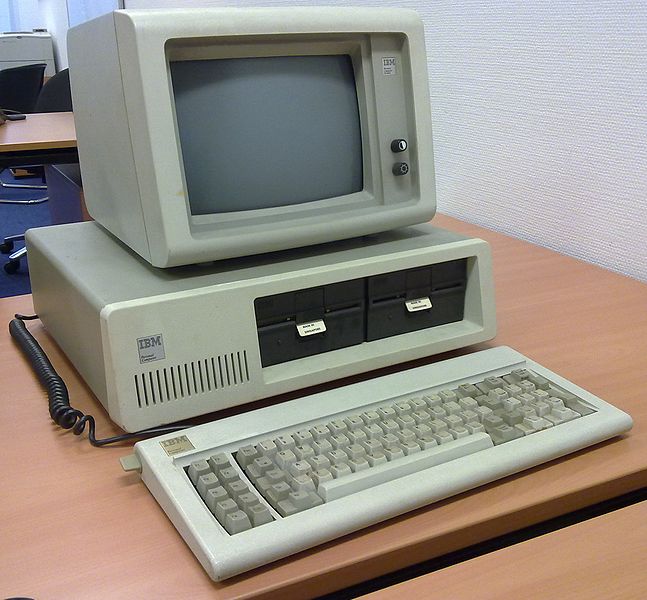
This day marks the release, 31 years ago in 1981, of the very first IBM Personal Computer (PC) model 5150.

The original IBM PC. (R de Rijcke, Wikimedia Commons)

Developed in less than a year, using existing off-the-shelf components, it proved a runaway success in the small business market, and launched the era of the personal computer. The IBM PC used an operating system developed by Microsoft, helping to establish Microsoft’s dominance in the in the PC market.

Specifications of the original IBM PC included an Intel 8080 processor with a processing speed of 4.77 MHz, 16-64K memory and data storage consisting of 5.25″ floppy drives, cassette tape and (later on) a hard disk.

Even though the term “personal computer” wasn’t first coined by IBM (it was used as early as 1972 in reference to the Xerox PARC Alto), the success and prevalence of the IBM product resulted in the term PC referring specifically to computers and components compatible to the IBM PC. This led to peripherals and components being advertised as ‘IBM format’, further cementing IBM as the industry standard.

The IBM Blue Gene/P system (2008), capable of 14 trillion individual calculations per second. Yep, it’s a bit faster than the IBM PC model 5150!
(© All Rights Reserved)

As a result of it’s amazing longevity (many IBM PCs have remained in use well into the 21st century), and the fact that it represents the first true personal computer, the original IBM PC have become popular among collectors of vintage PCs.

So, if you happen to still have an old model 5150 sitting in a cupboard somewhere, treasure it – depending on it’s condition it can be worth almost $5000, and unlike just about all other electronic equipment in your house, it’s value may actually increase!