Page 30 of 41

Getting solarised on Man Ray’s birthday

Today we celebrate the birthday of one of the great avant-garde photographers of the modern era – the enigmatic Man Ray. Born Emmanual Radnitzky (27 Aug 1890 – 18 Nov 1976) in Pennsylvania, US, he was the oldest child of Russian Jewish immigrants.

He changed his named to Man Ray in his early 20’s – ‘Ray’, a shortened form of Radnitsky, was something his brother came up with in reaction to the anti-Semitism prevalent at the time, while ‘Man’ came from his childhood nickname ‘Manny’.

Interested in art from an early age, Man Ray pursued a career as an artist after leaving school. Starting with painting as his medium of choice, he soon developed an interest in the avant-garde movement and became involved with the Dadaists in New York. He started investigating alternative image-making methods, including photography, as well as experimenting with various new artistic forms and techniques, including readymades (influenced by his friend Marcel Duchamp) and kinetic art.

In 1921 he relocated to the Montparnasse quarter in Paris, France, an area favoured by artists of the time. Over the next 20 years, he focused on photography, becoming an influential photographic artist and photographing many of the key figures in the art world, from James Joyce to Jean Cocteau.

While he made a notable contribution as painter, he is perhaps best remembered for his photography – he is responsible for some of the most iconic photographic images of the 20th century. Together with his assistant and lover Lee Miller, herself a surrealist photographer of note, he ‘reinvented’ the technique of solarisation when Lee accidentally over-exposed an image in his darkroom.
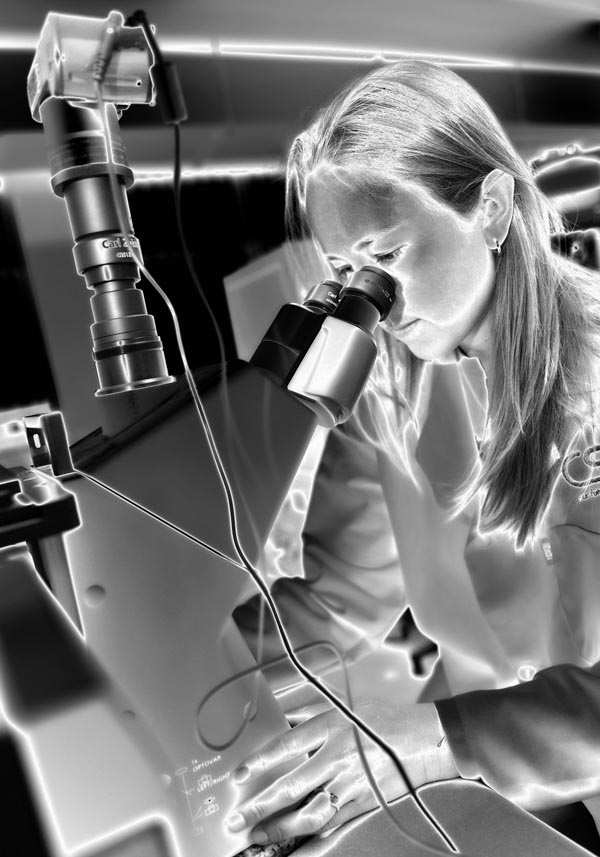
A digitally ‘solarised’ image. Given my science photography focus, I’ve opted for a scientific image to subject to the solarisation treatment.
(© All Rights Reserved)

Solarisation is the partial reversal of an image which occurs when a film or print is subjected to a brief period of extreme over-exposure. The effect was first discovered in the early 19th century and was already identified by photographic pioneers such as Daguerre and Draper, so Man Ray definitely didn’t invent the concept. He did, however, recognise the creative potential of this ‘accidental technique’, which usually occurs when a film or print is accidentally exposed to brief flash of light (like briefly switching on a light in the darkroom). He spent a lot of time and effort perfecting the technique, and produced some of the classic examples in this style.

While the solarisation technique is a physical, chemical process achieved during the development of a piece of photographic film or print, various digital processing techniques have been developed to mimic the solarisation effect – Adobe Photoshop even has a readymade ‘Solarize’ filter. A decent digital approximation of the solarisation effect can be achieved using tools like Photoshop, but it’s not quite the same as the real thing. It is definitely less exciting in the sense that you are almost in too much control of the effect – you can precisely control the levels of ‘digital solarisation’, unlike the physical situation where you are partially at the mercy of the chemistry of your medium, and the element of chance becomes an integral part of the artistic process.

Flowers make excellent subjects for solarisation.
(© All Rights Reserved)

Of course art is not just about the tools – whether you use a flash of light or a photoshop tweak to achieve a creative result, the technique will always be subservient to the artistic inspiration. In the words of Man Ray himself:

“… there will always be those who look only at technique, who ask ‘how’, while others of a more curious nature will ask ‘why’. Personally, I have always preferred inspiration to information.”
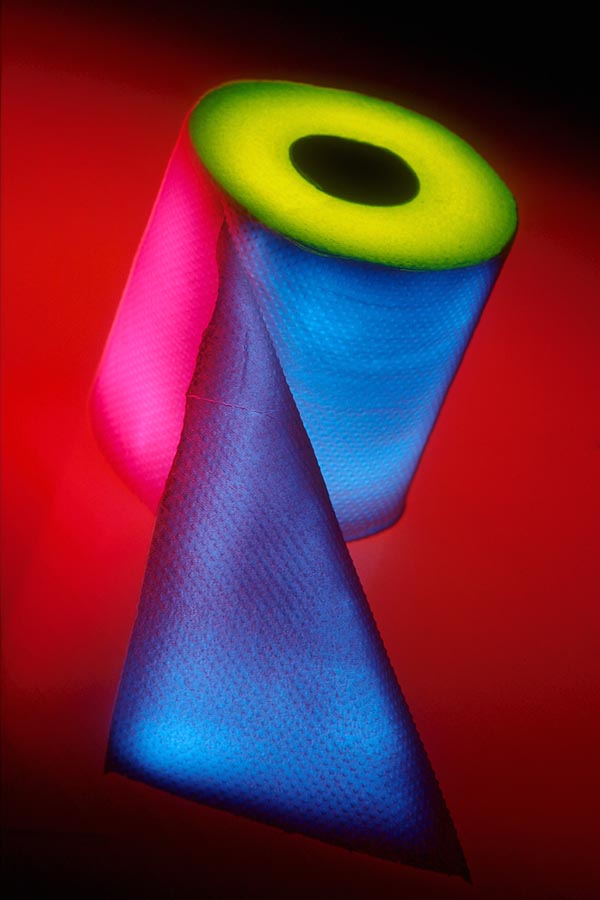

Celebrating the invention of toilet paper

Here’s an amusing story – today is the birthday of toilet paper! On this day back in the year 580 AD, the Chinese invented toilet paper (well, at least according to historyorb.com they did). I doubt the accuracy of this fact, as various sources give widely differing historic accounts of this rather personal product. It is, however, too good a topic to let pass, so I will accept it as true for now.

To make things more interesting, I have also found a site claiming that today is the day back in 1871 when toilet paper was first sold on a roll in the US, and that today is, in fact, National Toilet Paper Day in the States.

So whichever way you look at it, toilet paper’s shadow looms large over this day.

Spotlight on toilet paper – basic commodity or luxury item?
(© All Rights Reserved)

Of course, when you start thinking about “the first use of toilet paper”, the second thought that enters your mind almost immediately, is “what did they use before?”. Well, whatever was available, it seems – grass, leaves, moss, corncobs, coconut shells (I cannot quite get my mind around that one!), snow, sheep’s wool… The Romans, fancy buggers that they were, used sponges and salt water.

It does seem to be a generally accepted fact that it was the Chinese who introduced the use of paper for cleaning up after ‘the act’. The earliest recorded reference to the use of toilet paper seems to come from the Chinese scholar Yan Zhitui, who wrote in 589 AD: “Paper on which there are quotations or commentaries from the Five Classics or the names of sages, I dare not use for toilet purposes.” (According to Wikipedia.)

On a roll

Rolled and perforated toilet paper, similar to what we know today, only saw the light of day in the mid 19th century, with American Zeth Wheeler taking out a patent for it in 1871. It seems the commercial potential of purpose-made toilet paper was marred in the early days by the fact that people were too embarrassed to ask for it, or to be seen buying it, so Wheeler’s first company, the Rolled Wrapping Paper Company, failed to turn a profit. Things have obviously changed since then, with toilet paper today being a multi-billion dollar industry.

The future

It’s interesting to speculate about the future of bathroom hygiene.  Will toilet paper remain the product of choice in the Western world? A toilet known as the ‘Washlet’ (a toilet equipped with a bidet and air blower) is growing in popularity in Japan, while many countries in the Middle East and Asia prefer water cleaning. As we continue to exhaust the world’s natural resources, and manufacturing costs continue to rise, will a product as humble as the toilet roll become too much of a luxury item for many people to afford?

Interesting thought… Considering that the average American reportedly uses almost 60 squares of toilet paper a day, and the market for the product is booming in developing countries, it really is a huge volume of wood pulp that simply goes down the toilet – thousands upon thousands of trees are consumed daily by the toilet paper industry.

Over or under?

OK, time for a quick amusing fact:  In brand new research published in the US, a survey was done to find out whether Americans prefer their toilet paper to hang over or under the roll. The result? A staggering 75% of respondents preferred the paper hanging over the roll. Women appear to be even more adamant about this, as do people over the age of 60. Nevada turned out to be the ‘over-hanging’ capital of the US, with almost 100% preferring the over-the-roll option. For more have-to-know information, you can read more on the survey results here.

So how do you roll?

The birth of Linux, giant killer of the Open Source world

A while ago, I published a post on the start of the open source operating system revolution. As mentioned there, Linus Torvalds did not ‘invent’ the open source operating system with Linux, but there’s no denying that he is one of the true superstars of the open source world, and that Linux is, without a doubt, one of the few open source operating systems that have managed to make the big commercial players sit up and take notice.

From cellphones to supercomputers – Linux is a popular operating system across a wide range of platforms.
(© All Rights Reserved)

There is some debate around the date that should be considered the ‘official’ birthday of Linux – there are three early emails from Torvalds making reference to his operating system – but the general consensus seems to be that his email of 25 August 1991 best represents Linux’s inception:

From:torvalds@klaava.Helsinki.FI (Linus Benedict Torvalds)
Newsgroup: comp.os.minix
Subject: What would you like to see most in minix?
Summary: small poll for my new operating system
Message-ID: 1991Aug25, 20578.9541@klaava.Helsinki.FI
Date: 25 Aug 91 20:57:08 GMT
Organization: University of Helsinki.

Hello everybody out there using minix-

I’m doing a (free) operating system (just a hobby, won’t be big and professional like gnu) for 386(486) AT clones. This has been brewing since april, and is starting to get ready. I’d like any feedback on things people like/dislike in minix; as my OS resembles it somewhat (same physical layout of the file-sytem due to practical reasons) among other things.

I’ve currently ported bash (1.08) an gcc (1.40), and things seem to work. This implies that i’ll get something practical within a few months, and I’d like to know what features most people want. Any suggestions are welcome, but I won’t promise I’ll implement them 🙂

Linus Torvalds torvalds@kruuna.helsinki.fi

Originally developed for Intel x86 personal computers, the Linux operating system has since been ported to a wider range of platforms than any other operating system, ranging from servers to supercomputers to embedded systems. The Android operating system, used by a wide range of mobile devices, is built on a Linux kernel. Quite amazing for a system that it’s creator described as “just a hobby, won’t be big and professional like gnu”.

The Linux story really is a feel-good tale of how a non-commercial product, based on a free and open community-based development model, can match and exceed its multi-million dollar commercial competition.

Happy birthday, Linux, and power to you, Linus Torvalds – may you long continue to steer the ship, and take others along on your quest for the open and the free.

Celebrating George Crum and the birth of the potato chip

I should start today’s post with a bit of a disclaimer – while this tale is told as the truth, the exact date details are difficult to confirm. However, most references I could find stated the date as 24 August 1853, so here goes.

On the above date, Railroad magnate Commadore Cornelius Vanderbilt went dining at the Moon Lake House, a restaurant in Saratoga Springs, New York. He ordered french fries, but found the fries he received too thick, bland and soggy, so he sent them back to the kitchen. George Crum, the chef at the Moon Lake House, wasn’t impressed by what he considered to be an overly fussy customer, so he went overboard to address his concerns – he sliced the fries paper-thin, fried them to a crisp and seasoned them with a generous helping of salt. Much to his amazement, Vanderbilt loved the the crispy chips, so much so that the restaurant decided to add them as a regular menu item, under the name ‘Saratoga Chips’.

A few years later, in 1860, chef Crum opened his own restaurant, and he took pride in serving his ‘signature dish’, placing potato chips in baskets on every table.

Crispy, crunchy potato chips – not the healthiest snack around, but we cannot seem to get enough of them.
(© All Rights Reserved)

Despite the popularity of Crum’s invention, no-one recognised it’s potential as a mass-produced, off-the-shelf snack – it remained a restaurant delicacy until 1926, when Mrs Scudder began mass-producing potato chips packaged in wax paper bags. In 1938, Herman Lay started producing Lay’s Potato Chips, the first successful national brand in the US.

The rest, as they say, is history – chips (or crisps, as the Brits like to call them) have taken over the world, with the global chip market in 2005 generating total revenues of more than US$16 billion. That’s more than a third of the total savoury snack market for the year.

Of course, being deep-fried and doused in salt, chips aren’t exactly a health snack. They have been identified as one of the leading contributors to long-term weight gain, as well as being linked to heart disease. In response to these issues, potato chips companies are investing huge amounts in research and development of new, more health-conscious products. Frito-Lay, for example, have reportedly invested more than $400 million in new product development, including techniques to reduce the salt content in Lay’s potato chips without compromising taste.

Now flavour is one thing, but did you know that the crunch produced when we bite into a chip, also plays a significant role in our perception of the snack? According to a New York Times article, a team of psychologists at Oxford University conducted an experiment where they equipped test subjects with sound-blocking headphones, and made them bite into potato chips in front of a microphone. In different test runs, using the exact same chips, the sound of the crunch was processed in different ways and passed back to the testers via the earphones. Taking their perception of the unaltered sound as the benchmark, they found that when the crunchy sound was amplified, testers considered the chips to taste fresher and crispier, while muting the crunch resulted in the same chips being rated as less crispy and stale.

Hmmm, all this talk about crunchy chips is making me hungry – I can definitely do with a bag of good old Salt & Vinegar chips right about now!

Joining hands on Black Ribbon Day

Today is International Black Ribbon Day; also celebrated as the European Day of Remembrance for Victims of Stalinism and Nazism in Europe. While it is a day highlighting a dark part of history, more than anything else, today is a celebration of the human spirit, about unity and about how amazing things can be achieved by joining hands and standing together (quite literally, in this case).

Joining hands to overcome hardship (and to solve mathematical problems!).
(© All Rights Reserved)

Black Ribbon Day originated in the 1980s, as a annual series of demonstrations, held on 23 August in various western countries to highlight crimes and human rights violations in the former Soviet Union. The date marks the anniversary of the signing of the Molotov-Ribbentrop pact between the Nazi and Soviet Communist regimes – an event described by President Jerzy Buzek of the European Parliament as “the collusion of the two worst forms of totalitarianism in the history of humanity.”

Starting with initial participation of western countries only, it spread to the Baltic states in 1987, and in 1989 culminated in a historic event known as the Baltic Way. The Baltic Way, also referred to as the Baltic Chain, the Chain of Freedom and the Singing Revolution, was a peaceful demonstration involving almost two million people joining hands to form a 600km long human chain across the three Baltic states (Estonian SSR, Latvian SSR, and Lithuanian SSR), to protest against continued Soviet occupation.

The Baltic Way was meant to highlight the Baltic states’ desire for independence and to show the solidarity between the 3 nations. It proved an effective, emotionally captivating event. Within 6 months of the protest, Lithuania became the first Republic of the Soviet Union to declare independence, with Estonia and Latvia following in 1991.

Now you may be wondering why I’m discussing International Black Ribbon Day and the Baltic Way on this blog. Well, besides it being an opportunity to celebrate the strength of the human spirit in overcoming adversity, what caught my attention was something small and (almost) unrelated that grew out of it – the Baltic Way Mathematical Contest.

This maths contest has been organised annually since 1990, in commemoration of the Baltic Way human chain demonstrations. It differs from most other international mathematical competitions in that it is a true team contest. Teams, consisting of 5 secondary school students each, are presented with 20 problems, and they have four and a half ours to collaboratively solve these.

Initial participation was limited to the three Baltic states, but the competition has grown to include all countries around the Baltic Sea. Germany participates with a northern regions team, and Russia with a team from St Petersburg. Iceland has a special invitation for being the first state to recognise the independence of the Baltic States, and guest countries (including Israel, Belarus, Belgium and South Africa) have been invited in particular years, at the discretion of the organisers.

From people joining hands to overcome political hardship to students teaming up to solve complex mathematical problems, today truly is a day to celebrate strength in unity.

Chasing away the winter blues with a roisterous “Hoodie-Hoo!”

Today us folk in the Southern Hemisphere get our turn to celebrate ‘Hoodie-Hoo Day’ (about 6 months after the Northern Hemisphere version). So what is Hoodie-Hoo? Well, in a nutshell it’s the day where we should all go outside at noon, drink in the (hopefully) warming weather and at the top of our lungs yell “Hoodie-Hoo!!” to chase away the winter blues and to celebrate the fact that spring is on it’s way.

According to some sources, you can celebrate the day in even more authentic style by donning a funny or unusual hat while performing your celebratory shouting.

‘Southern Hemisphere Hoodie-Hoo Day’, and its companion ‘Northern Hemisphere Hoodie-Hoo-Day’ are two of 80-odd holidays dreamt up by the folks over at Wellcat.com, a herbal company who felt the world simply didn’t have enough holidays, and came up with a bunch of new ones under the moniker of “Wellcat Holidays”.

The reason I decided to feature this day is that it got me thinking about this amazing time of year, when the seasons almost imperceptibly start changing. It is more often than not still cold and miserable, but everyone knows it’s not quite winter anymore – animals stir from hibernation, trees start budding all over the place, flowers appear as if by magic and there really is a sense of anticipation in the air.

The fruit trees in our garden, including this plum, are all doing their blossomy version of the Hoodie-Hoo.
(© All Rights Reserved)

Ever wondered how plants know spring is approaching? In a New Yorker article I found, Dr Susan Pell from the Brooklyn Botanical Garden explains things very nicely. According to Dr Pell, “Why and how plants flower when they do is something that has puzzled botanists for centuries. We’ve come a long way, but there is still quite a bit about the signalling details that we don’t know. There are many factors involved, but given the right growing conditions (soil nutrients, water and sun exposure), day length and ambient temperature are the key factors.”

Various proteins in the plant (such as phytochrome and cryptochrome) can actually sense the relative lengths of the light and dark parts of the day. (This is an example of photoperiodism.) Furthermore plants also sense ambient temperature, with some plants requiring a cold snap before they will start flowering. Once the nights become short enough and the temperature reaches the right level, growth, and specifically flowering, is triggered in the plants. As far as temperature is concerned, plants tend to not be fooled by a single unexpected warm day, but rather react to a sustained warm period. If such a period occurs too early, it can trick the plant into flowering earlier than it is supposed to, which could expose the fresh growth to frost damage in a subsequent cold spell. The plant’s light and dark sensing abilities should keep this from happening, but particularly in cities with lots of artificial light, these sensors may be too confused to function correctly.

Dr Pell furthermore says, “The hypothetical protein that signals plants to bloom once the ideal conditions have arrived has long been called ‘florigen‘, but it is uncertain whether or not it has actually been identified.” Claims to its identification has been made in various research papers, but no conclusive evidence have been presented.

I sometimes wonder whether us humans also have our own florigen-like trigger telling us that spring is on its way? One definitely gets a sense that the seasons are changing – this sense of new life stirring – even before you see spring flowers appearing. The world not only looks different (subtle changes in the colours of the sky and the land), but it also feels different – an early morning jog is still nippy as hell, but the cold somehow starts to feel refreshing, rather than depressing.

I don’t know – perhaps its merely the fact that my diary tells me spring is on its way that makes me see and feel things.  Whatever the case may be, and whether it’s florigen induced or not, I am definitely going to let rip with a loud ‘Hoodie-Hoo’ holler today!

(And to all my Northern Hemisphere friends – hang in there, and mark 20 February in next year’s diary. It may still be six months off, but your chance to ‘Hoodie-Hoo!’ is coming – better start practicing!)

Poet’s Day, mathematically speaking

Today is Poet’s Day, a day to celebrate the sensitive souls who, through the ages, shared their deepest thoughts through verse and rhyme. I have to admit to being more of a ‘prose person’ than a ‘poetry person’, but that by no means implies that I don’t have the greatest respect and admiration for a good poem – it’s simply not my very favourite literary form.

Of course there’s a close relation between poetry and mathematics – a subject that is close to my heart. It was Einstein who said: “Pure mathematics is, in its way, the poetry of logical ideas.”

Mathematics in general seem to play an important role in poetry. Not only is there mathematics in the structure and rhythm of poetry, but many poems have also been written that contain overt mathematical themes. In a 2010 article entitled Poetry Inspired by Mathematics, Sara Glaz from the University of Connecticut, discusses some examples of such poems. More examples can be found in an earlier article from 2006 by JoAnne Growney, Mathematics in Poetry. In the latter article, Growney elegantly states, “As mathematicians smile with delight at an elegant proof, others may be enchanted by the grace of a poem. An idea or an image expressed in just the right language–so that it could not be said better–is a treasure to which readers return.”

The wonderful Fibonacci number sequence not only pops out in nature, but now claims its place in the world of the poet as well.
(© All Rights Reserved)

An interesting new poetic form which I’ve discovered while doing some background reading for today, is the so-called “Fibonacci poetry”, which is based on the Fibonacci number sequence. Fibonacci numbers are a sequence, starting with 0 and 1, where each subsequent number is the sum of the previous two, i.e. 0,1,1,2,3,5,8,13,21,34,…

Fibonacci numbers occur often in nature, as I’ve discussed in an earlier blog post.

In poetry, the number sequence can refer to the numbers of letters, syllables or words in successive lines of the poem. These poems, known as ‘Fibs’, are six lines long, typically starting with a single letter/syllable/word in the first line. They can, however, theoretically start with any number of letters/syllables/words in the Fibonacci sequence.

Even though this form, originally introduced by Gregory K in a blog post on the GottaBook blog, appears to still be more popular among mathematicians than among poets, it has managed to garner a mention in the New York Times Books section. Their example, based on syllables, neatly illustrate the concept:

Blogs 
spread 
gossip 
and rumor 
But how about a 
Rare, geeky form of poetry?

I like the idea, I really do – very cool indeed! So, without further ado, herewith my own humble Fib for the day:

Words
and
numbers
sequences
not just in nature
but warming the hearts of poets too.

(uhm, assuming ‘poets’ is a single syllable word, of course…)

Happy Poet’s Day, everyone!  And please do share some Fibs, if you’re that way inclined!

Inspiring blog award

Katie over at Anthropology Gallery kindly nominated me for the Inspiring Blog Award. Thanks Katie, I really appreciate it! Have a look at Katie’s blog – she’s a great blogger and it’s well worth the visit!

The rules for the award are as follows:

  • Acknowledge and thank the giver.
  • Link back to the nominator’s blog.
  • Put the award on your Homepage.
  • List seven things about yourself.
  • Give the award to seven bloggers who inspire you.

So here goes… Seven things about myself:

1) I love dessert – making it, eating it, reading about it, photographing it
2) I’ve completed a five-day ultra-marathon
3) I was a mathematician before opting for a career as photographer
4) I have an unusually high ape index (google it!)
5) I met my wife in a History of Art class
6) I’ve been on four continents; lived on two
7) Twenty years from now I will be twice as old as I was 12 years ago.

I’d like to nominate the following 7 blogs for the Inspiring Blog Award:

Buried words and Bushwa
Cristian Mihai
Dad Knows
Leanne Cole
The Millennium Conjectures
Anton P. Zoghi Photography
Nonoy Manga

Peristaltic pumps and artificial hearts

A hearty good day to everyone, and welcome to the new week. And yes, today ‘hearty’ is indeed the operational word, as this seems to have been an important day in history as far as the heart is concerned.

The heart, symbol of life and love.
(© All Rights Reserved)

Heart pump

Today we celebrate the birthday of Jerome Murray (20 Aug 1912 – 7 Jan 1998), an American inventor who invented the peristaltic pump that made open-heart surgery possible. The pump was unique in that it was able to pump blood without damaging the human cells, through a method of expansion and contraction that imitates the peristaltic process.

Artificial heart

Exactly 10 years after Murray’s birth, the Japanese surgeon Akutsu Tetsuzo (20 Aug 1922 – 9 Aug 2007), was born. Tetsuzo was the surgeon who built the first artificial heart that was successfully implanted into an animal. The heart that Tetsuzo developed was implanted into a dog on 12 Dec 1957, and kept the dog alive for about an hour and a half. While this may not be very long, it did open the door to further research into the domain, eventually leading to the succesful development of artificial hearts for humans.

So, even though today is not officially a heart holiday, it is clearly quite an important day in the history of the heart, and particularly the research and development of artificial technologies to support the human heart.

Spare a thought for your heart – it’s an amazing organ, and everyone who can live out their lives with their own, healthy hearts should count themselves really lucky. If something does go wrong, however, at least it’s good to know that there are clever people like Jerome Murray and Akutsu Tetsuzo in the world, who consider it their lives’ task to develop the incredible technologies that help keep us ticking along.

Grab your camera, it’s World Photography Day!

Whether you’re a professional photographer or just someone who likes pointing and shooting for fun, today is especially for you – it’s World Photography Day!

Today is a day for those of us who spend our days, camera in hand, in pursuit of what my all-time favourite photographer, the Frenchman Henri Cartier-Bresson, termed ‘the decisive moment’.
(© All Rights Reserved)

August 19th was selected for World Photography Day as this is the day that the Daguerreotype process was released to the world. The Daguerreotype, a process whereby a direct positive image is created in the camera on a silvered copper plate, was the first commercially successful photographic process, and was developed by Louis Daguerre together with Joseph Nièpce. Nièpce died in 1833 before it was completed, but Daguerre continued refining the process to improve the exposure time requirements and to make the fixing of the image more effective (to prevent darkening of the image over time).

The refined daguerreotype process was announced by the French Academy of Sciences on 9 January 1839. Daguerre did not patent the invention, instead choosing to hand over his rights to the French government in exchange for a lifetime pension. The agreement was further that the government would present the daguerreotype process as a ‘gift to the world’ – this happened on 19 August 1839, when details about the process was released into the public domain.

In the same year, William Fox Talbot announced his silver chloride ‘sensitive paper’ process. With both these landmark events taking place in 1939, this is generally regarded as the year photography was born.

But getting back to World Photography Day 2012 – this year marks the first World Photography Day competition and with $12,000 worth of prizes to be won, it’s well worth investigating. Submissions can be uploaded between 19 and 22 August, so don’t delay, check it out now.

Happy shooting, everybody!