Page 26 of 41

Techies Day and the growing need for skilled high-tech workers

According to the Merriam-Webster dictionary, a ‘techie’ is defined as “a person who is very knowledgeable or enthusiastic about technology and especially high technology”. And today, I am told, is Techies Day, launched in 1999 by Techies.com. Yes indeed, when no-one else bothered to create a day for appreciating the techies, they just did what any good techie would do and created it themselves. Gotta love a techie!

All jokes aside, this is the day to take some time to acknowledge and appreciate all the ways in which your life is made easier thanks to a baffling array of techies – the guys and gals who keeps the telecommunications systems communicating; who ensure the computing systems keep computing; who keep our ever increasing collection of digital devices up and running; who enable the blogging platforms to keep on supporting the 433,743 bloggers, 1,058,607 new posts, 1,283,513 comments, and 246,669,831 words posted every day (and that’s just on our favourite platform).

Take time today to show some love and appreciation for the techies in your life.
(© All Rights Reserved)

Internationally there’s an ever growing demand for qualified technology workers, and a growing recognition of the need for initiatives aimed at drawing more bright young people into technology domains. In a ComputerWeekly report from April this year, the lack of IT talent is described as a ‘global issue’ by recruitment group Hays, who has pinpointed IT as “one of the top ‘hard skills’ in demand” in their list of top ten skills that are globally lacking. The article further points out that, while international outsourcing is still a popular option for many companies to address their shortages, there is a trend to rather try to attract the skills to develop projects in-house.

The situation is no different down here in New Zealand. As reported in the NZ Herald, Minister of Economic Development Steven Joyce , while addressing the Nethui Internet Conference, said “There is a worldwide shortage of ICT skills currently and it’s not getting any better and New Zealand is part of that. One of the challenges for all of us, particularly those of you who are evangelists for the digital revolution, is actually to get schools, people, students, families to get more focused on ICT careers because there is a danger that the focus on the skills, that will be required, lags [behind] the opportunities.”

The ICT domain keeps expanding, requiring more and more techies to keep it up and running.
(© All Rights Reserved)

So, the next time you interact with a techie and he/she looks a tad stressed, have some sympathy – they’re probably overstretched and can do with some appreciation. Too often these days we consider the IT systems and connectivity supporting our lives a right and not a privelege, and we get righteously peeved off when things go wrong and take it out on the first line of support we hit.

Today, instead of fighting, show some love for the techies in your life.

Happy Techies Day, everyone.
Celebrating the International Day of Non-violence

The UN seems to be busy in October. Following hot on the heels of our discussions on World Rivers Day and yesterday’s World Habitat Day, today features another UN observance, the International Day of Non-Violence.

October 2nd is the commemoration of the birth of Mahatma Gandhi, whose philosophy of non-violent civil disobedience paved the way for Indian independence and inspired movements for non-violence, civil rights and freedom across the world. A most suitable date, therefore, to be declared International Day of Non-Violence by the UN General Assembly in 2007. The aim of the day is to promote and disseminate the message of non-violence in different ways, including through education and public awareness. It reaffirms “the universal relevance of the principle of non-violence” and the desire “to secure a culture of peace, tolerance, understanding and non-violence”.

“It may be easier to pick up a weapon than to lay down a grudge. It may be simpler to find fault than to find forgiveness” – UN Secretary-General, Ban Ki-moon.
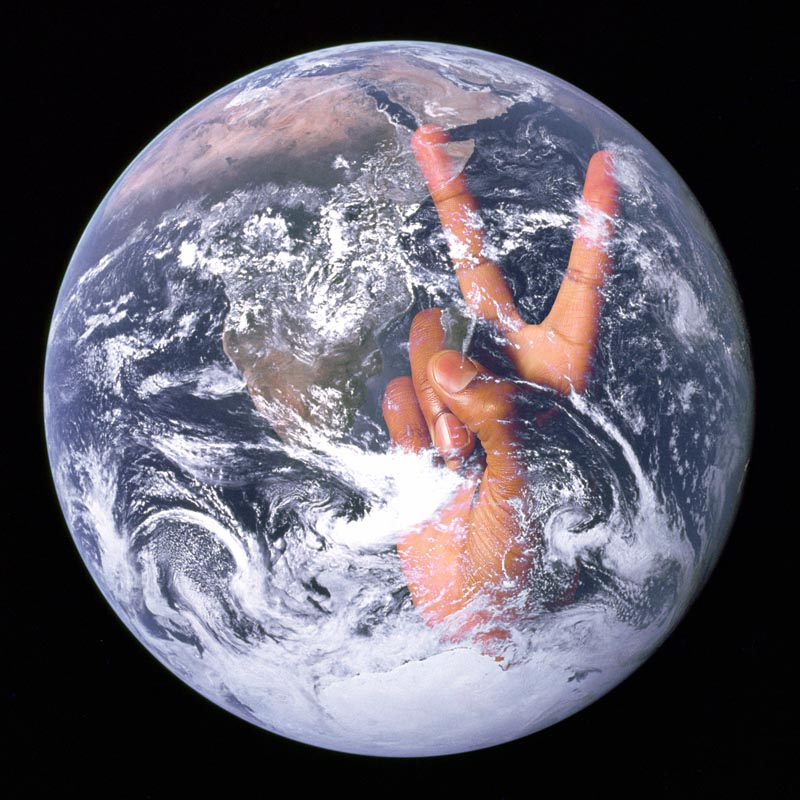
(The above image incorporates “The Blue Marble” photograph of Earth, taken from Apollo 17.)

Non-violence, or non-violent resistance, as it is also known, is about achieving social or political change without resorting to physical violence. It is a form of social struggle that has been successfully adopted by groups the world over in social justice campaigns, and has rightfully been referred to as ‘the politics of ordinary people’. In the words of UN Secretary-General Ban Ki-moon, “the foundation for non-violence will be built by people: teachers and faith leaders, parents and community voices, business people and grass-roots groups”.

The three main categories of non-violent action are:

  • protest and persuasion, including marches and vigils;
  • non-cooperation; and
  • non-violent intervention, such as blockades and occupations.

Non-violence thus does not imply a lack of action. It is a very active instigator of change, only achieved without violence, and this is what gives it such power. The Occupy Wall Street movement we discussed recently would be a good recent example of citizen-led non-violent resistance.

In celebration of this day, perhaps the most succinct and profound statement comes from the great Gandhi himself:
“There are many causes that I am prepared to die for but no causes that I am prepared to kill for.”

World Habitat Day and the challenges of urbanisation

The first Monday of October has been designated by the United Nations as World Habitat Day. The day is all about reflecting on the state of our towns and cities, and reminding the world of its collective responsibility for the future of the human habitat.

The theme of this year’s World Habitat Day is ‘Changing Cities, Building Opportunities’, with the focus being on cities as the world’s growth engines – currently more than half the world’s population live in towns and cities, and within a generation, that number will rise to two-thirds. It is also said that by 2030, up to 60% of these urban dwellers will be under the age of 18. The reason people flock to the cities in ever increasing numbers is that it is seen as the place where they can realize their dreams of a better life. Well planned and well built cities can provide a healthy support structure for this urbanisation; unplanned growth leads to chaos and urban sprawl.

Auckland, NZ. With a population of almost 1.4 million it is small by world standards, yet big in New Zealand – it is home to almost a third of the country’s population, and growing. The city thus aptly markets itself as the ‘Big Little City”.
(© All Rights Reserved)

Urbanisation brings with it major challenges, but also great possibilities. To quote Dr Joan Clos, Executive Director of World Habitat Day 2012:

“The main challenges confronting cities and towns all over the world today include unemployment, especially among youth; social and economic inequalities; unsustainable energy consumption patterns; urban sprawl; high percentages of people living in slums; high levels of vulnerability to natural disasters; inadequate urban basic services, especially water, sanitation and energy; poor mobility systems and increasing emissions of greenhouse gases. 

Given that, historically, urbanisation has been a source of development rather than a result of it, it is clear that it can be used as a powerful tool for transforming production capacities and income levels in developing countries. This requires a mindset shift on the part of decision makers, away from viewing urbanisation as a problem, and instead towards seeing it as a tool for development.

Major changes are necessary. We have the science and the knowhow. And we know too that our ever growing cities are just where the changes can be implemented fastest and new opportunities created. We must all become city changers.”

Through the last line of Dr Clos’ message, World Habitat Day also ties in nicely with the wider UN-Habitat ‘I’m a city changer’ initiative. The idea being that making cities a better place to live is not just the responsibility of the authorities and the city planners, but that ordinary citizens can get involved as well. The initiative promotes these 10 reasons to be a city changer, and have released the little video below to promote the concept.

Some damming thoughts on World Rivers Day

Since 2005, the last Sunday of September has been celebrated annually as World Rivers Day. This global celebration of the rivers around the world is aimed at highlighting the value of rivers and the importance of sustaining river health. Global activities include riverside cleanups, school projects, art exhibitions, music festivals and more.

World Rivers Day originated in Canada, where a very successful BC Rivers Day, held in British Columbia since 1980, led to the creation of Canadian Rivers Day. This eventually gave rise to World Rivers Day, launched in 2005 as part of the United Nations’ Water for Life Decade initiative.

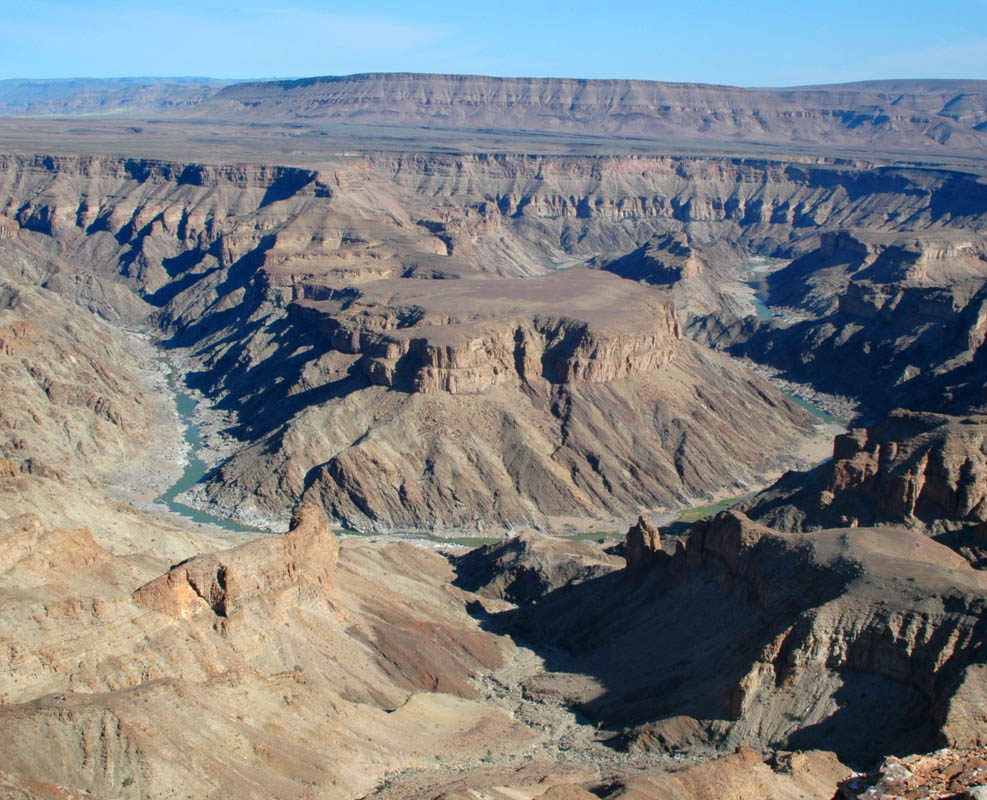
The Fish River Canyon, Namibia. Rivers are the arteries of the earth – keeping them clean, unblocked and free-flowing is critical for the health of the planet.
(© All Rights Reserved)

According to the World Rivers Day website, the two key global issues requiring attention are the decline of river fish populations and the construction of dams.

The construction of large dams in rivers can have severe environmental, economic and human impacts.

Environmentally, one of the biggest issues relate to the impact of dams on fish populations – dam walls block fish migrations and in some cases completely separate the fish’s spawning habitats from their rearing habitats, which can have disasterous effects on river fish populations. The dam walls also trap sediments, affecting physical processes and habitats downstream. The establishment of a dam also changes the upstream part of the river from a free-flowing ecosystem to a stationary reservoir habitat, affecting it chemically and physically, threatening existing fauna and flora and introducing new, invasive species. To quote the International Rivers Organisation, “Large dams have led to the extinction of many fish and other aquatic species, the disappearance of birds in floodplains, huge losses of forest, wetland and farmland, erosion of coastal deltas, and many other unmitigable impacts.”

Large dams are an important source of hydropower and drinking water, but they can have negative economic impacts as well. Aside from the huge cost of building and maintaining these dams, excessive dependence on hydropower can be a risky strategy in a world where climate change can severely affect rainfall patterns, potentially leading to drought induced power blackouts. While hydropower is an important sustainable power source, and an important part of an energy-secure future, it should be included as one component in a diversified power supply regime (including wind, solar etc) to mitigate economic risk.

Finally, there is the human impact, with the World Commission on Dams estimating that the development of large dams have forced between 40 and 80 million people from their land in the past half century. This has particularly impacted the poorer countries of the world, where most of the world’s large dams are being constructed. Beyond those directly displaced by the dam reservoir, large dams affect millions of people living downstream and upstream from the dam, as availability of clean water, food sources and other natural resources have been affected. Changed ecosystems, particularly in the tropics, have also resulted in the introduction of diseases like urinary and intestinal schistosomiasis (bilharzia).

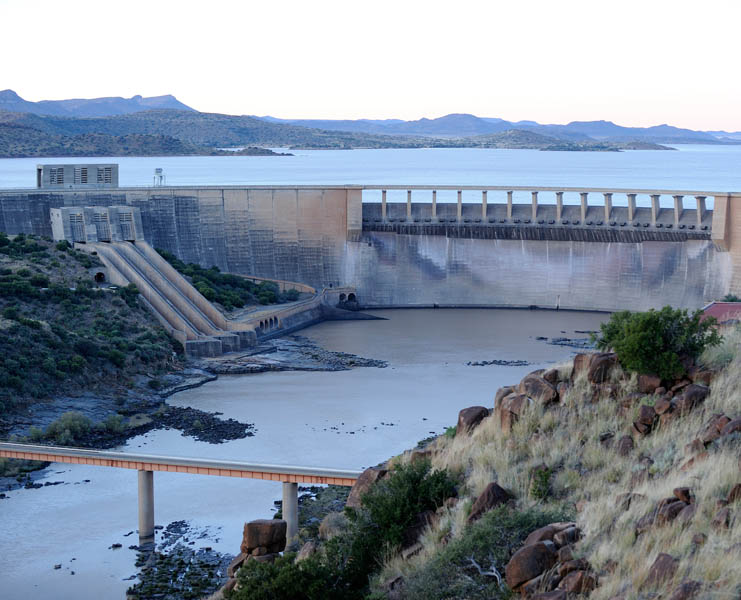
The Gariep Dam, South Africa. Dams are critical sources of energy and continuous water supply, but can also severely affect river-related ecosystems.
(© All Rights Reserved)

Considering the importance of dams in energy creation, provision of drinking water etc, a balance obviously has to be struck between the advantages and disadvantages of building dams. Perhaps the key message lies in the following recommendation from the World Commission on Dams:

“Rivers, watersheds and aquatic ecosystems are the biological engines of the planet. They are the basis for life and the livelihoods of local communities. Dams transform landscapes and create risks of irreversible impacts. Understanding, protecting and restoring ecosystems at river basin level is essential to foster equitable human development and the welfare of all species.

Options assessment and decision-making around river development prioritises the avoidance of impacts, followed by the minimisation and mitigation of harm to the health and integrity of the river system. Avoiding impacts through good site selection and project design is a priority. Releasing tailor-made environmental flows can help maintain downstream ecosystems and the communities that depend on them.”

Savouring your favourite brew on International Coffee Day

Today is International Coffee Day. So after yesterday’s post on Arthur Guinness’ stout, this is my second post in a row discussing a dark brew loved the world over. And in a way the similarities between a pint of Guinness and a cup of coffee doesn’t end there – both contain antioxidants that are good for you. Yet like the alcohol in beer, the caffeine in coffee is addictive, and taken in excess is decidedly not good for you.

This, however, is not going to be a sober analysis of the medical risks and benefits of coffee and caffeine. I’ll admit it – I’m a bit of a coffee-holic. There are few things I like more than a well-made Americano in a quaint coffee shop rich with the smell of of freshly ground coffee, on a bustling city street corner. And if that coffee comes with a slice of lemon meringue (the perfect compliment to a good cuppa, if you ask me), even better.

So I am a tad biased. (And honestly, in moderation coffee can be good for you!)

Black or white, selecting your preferred style of coffee is a very personal choice.
(© All Rights Reserved)

International Coffee Day is the day coffee lovers can celebrate their shared love of their favourite brew. Americano, cafe au lait, espresso, caffe latte, capuccino, affogato, cafe mocha… the list of formats you can choose to enjoy a cup of coffee is long, decadent and rather daunting. And if that’s not enough, there’s regional names, like our New Zealand ‘long blacks’ and ‘flat whites’. Enough to make your head spin, even before your caffeine fix! But most coffee lovers will quickly settle on their personal favourite, depending on their preference of strength of the brew, inclusion (or not) of milk/foam/cream, etc. And don’t try to come between the coffee lover and his brew of choice!

Beyond celebrating coffee, today is also an opportunity to promote ‘Fair Trade certified’ coffee, purchased from growers who ensure decent conditions for their workers. It is a chance to raise awareness for the plight of those who work in poorer countries and environments where there may be few, if any, restrictions on labour conditions, and where the opportunities for exploitation is rife. When choosing your brew, make sure it’s Fair Trade certified.

In a positive worldwide trend, the popularity of Fair Trade coffee has increased consistently over the last decade, with the percentage of coffee sourced from Fair Trade producers increasing annually.

Kick-start your day with a Fair Trade certified cuppa at breakfast.
(© All Rights Reserved)

While choosing Fair Trade coffee rightly makes you feel better about your cuppa, there has been criticism about the ethics of it all, with cynics claiming Fair Trade certification to be little more than a marketing ploy to increase the price of the product, with only a small margin of this filtering through to the growers.

While this may sadly be true, my personal opinion is that opting to buy Fair Trade remains pretty much the only option to consumers wanting to buy from a non-exploitative source – surely that must be better than not supporting fair trade principles at all?

Black or white, sweet or bitter, whatever you prefer, join me in celebrating Coffee Day – here’s hoping you find a memorable brew today. And that a decent portion of the money you spend on it reaches the source!

Arthur Guinness’ brew is good for you!

Yep, it’s a big day down the pub today – we celebrate the birthday of Irishman Arthur Guinness, entrepreneur, philanthropist, and most importantly, founder of the Guinness brewery.

Arthur Guinness’ exact date and place of birth is not known, with some indications being that he was born in late 1724 or early 1725, while others point to a date later in 1725.  In the early 1990’s the Guinness company decided to put an end to the speculations, and proclaimed its founder’s ‘official’ date of birth to be 28 September 1725. This date, affectionately known as ‘Arthur’s Day’, has been enthusiastically celebrated by fans of his dark brew ever since.

Arthur Guinness’ legacy lives on in Guinness, one of the world’s most successful and well known beer brands, brewed in almost 60 countries and available in more than 100. Guinness and Co merged with Grand Metropolitan plc in 1997, and has since become part of the multinational alcohol conglomerate Diageo.

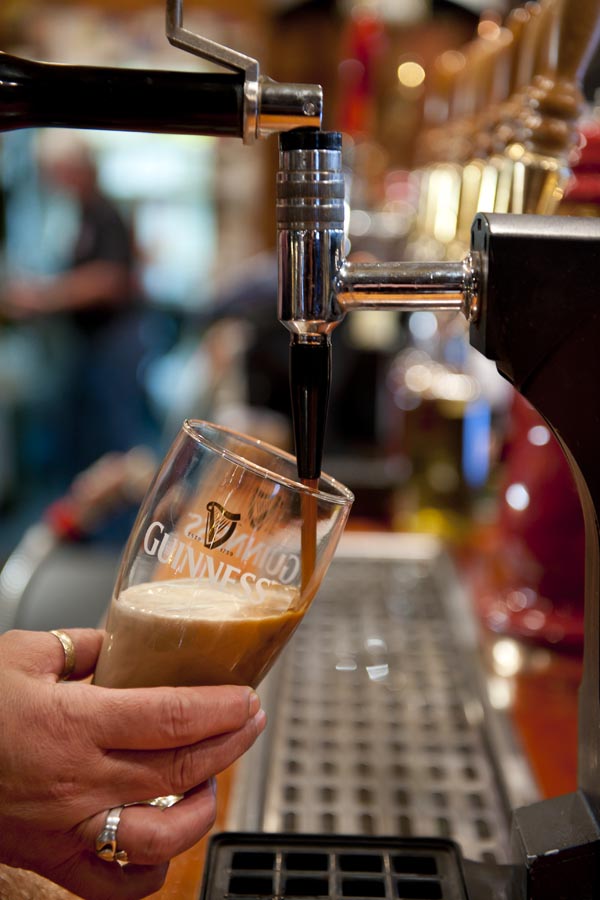
According to Diageo, the perfect pint of Draught Guinness is poured by means of a ‘double pour’ method, which should take exactly 119.53 seconds. When poured, the draught passes through a 5-hole restrictor plate which increases the pressure and creates small bubbles in the beer, resulting in the classic creamy head. This first pour is allowed to settle, whereafter the glass is filled with a second ‘slow pour’ until the head creates a slight dome at the top of the glass.
(© All Rights Reserved)

Guinness’ marketing has always been one of its strong suits, and this is a significant contributing factor to the continued popularity of the brand. The classic Guinness advertising series was created in the 1930s and 1940s, mostly illustrated by the artist John Gilroy. The advertising posters included classic phrases still seen in Irish pubs all over the world, such as “My Goodness, my Guinness”, “Lovely Day for a Guinness”, and most famously “Guinness is Good for You”.

The “Guinness is Good for You” slogan actually dates back to the 1920s, and stemmed from a market research campaign where people told the company that they felt good after a pint of Guinness. Beyond the feel-good factor, the stout was also considered to have some medicinal benefits – it was given to post-operative patients and blood donors, based on the belief that it was high in iron. It was also popular with pregnant women and nursing mothers.

The question “Why do Guinness’ bubbles travel downwards?” has been the subject of many a conversation down the pub. It is actually only the bubbles along the outer edge that moves down, as a result of drag – bubbles in the centre of the glass can travel upwards unhindered, while those along the edge are slowed down by the glass. As the beer in the centre rises, the liquid near the edge has to fall, and the resulting downward flow pushes some tiny bubbles downwards. Try explaining that after a few pints!
(© All Rights Reserved)

What’s interesting is that research more than half a decade later indicates that perhaps the ‘good for you’ claim wasn’t so far off the mark, albeit for different reasons. As reported by BBC News in 2003, “A pint of the dark stuff a day may work as well as a low dose of aspirin to prevent heart clots that raise the risk of heart disease.”

Researchers from the University of Wisconsin tested the stout by administering it to dogs who had narrowed arteries similar to those in people with heart disease. They found that the dogs fed different daily doses of Guinness had reduced clotting activities in their blood, while a control group of dogs given a lager beer did not show similar improvements. The research team furthermore claim that the greatest benefit was achieved when test subjects received about a pint each day at mealtime. Their conclusion was “that ‘antioxidant compounds’ in the Guinness, similar to those found in certain fruits and vegetables, are responsible for the health benefits because they slow down the deposit of harmful cholesterol on the artery walls.”

In response to these claims, Guinness’ owners Diageo simply said “We never make any medical claims for our drinks.” Despite this, I am sure millions of Guinness fans the world over will be more than happy to call on the ‘irrefutable scientific research’ above to justify their daily mealtime pint.

So here’s to Arthur and his famous brew – cheers, everybody!

Google – 14 years of searching and so much more.

Search giant Google turns 14 today. Quite incredible, isn’t it? I still remember so clearly when Google first arrived on the scene like a breath of fresh air in the late 90’s – simple, clean, effective.

Special Google doodle for the company’s 14th birthday.

With the search engine trend at the time being to desperately try and be all things to all people (the dreaded ‘one-stop portal syndrome’), Google was startling in its simplicity. Going completely against the portal trend, it presented a simple search engine that was nothing but a search engine. And people flocked to it in droves, so much so that Google completely changed the search landscape, becoming so ubiquitous that ‘googling something’ became part of everyday speak.

Of course it wasn’t all that simple – Google was brilliantly designed, and it’s search engine quite frankly took Internet searching to a new level. Where conventional search engines used search term counts to rang results, Google’s founders Larry Page and Sergey Brin came up with the innovative idea of calculating a page’s relevance by the number of pages (and the importance of these pages) that linked back to the original page. This approach, called ‘PageRank’, proved much more effective in providing relevant and useful search results.

Combined with it’s unofficial slogan “Don’t be evil”, Google’s mission statement has always been “to organize the world’s information and make it universally accessible and useful”. And they’ve certainly been effective at that.

Since it’s search engine beginnings, Google has grown to incorporate a huge range of disparate products and applications, including Google Docs, Google Maps, Gmail, Google Translate, Google News, Google Buzz and more.

A significant step in Google’s continued expansion has been the release of it’s Android operating system for mobile devices, which it acquired and subsequently released as an open source project. Andoid has since become one of the dominant mobile platfoms in smartphones, tablets and the like. Another open source initiatives that Google has ventured into is the Google Chrome web browser, followed by the Google Chrome OS, an open source Linux-based operating system.

In 2011 Google launched Google+, their social networking service to compete with Facebook. After 4 weeks of operation, Google+ claimed to have reached 25 million users, and there has been predictions of the service reaching 400 million users by the end of 2012. (Uptake of this service has, however, not been quite up to expectations, with Todd Wasserman from Mashable reporting earlier this year that the amount of time people are spending on Google+ has been constantly decreasing since the end of 2011, and appears negligeable compared to time users still spend on Facebook.)

The past 10 years saw incredible growth and diversification from Google – some people (myself included) feeling that perhaps they’re spreading themselves too wide, again approaching the ‘all things to all people’ trap they so impressively sidestepped when they first appeared. As with any supersize company, they’ve also had their share of criticisms – some valid, some less so – regarding their operations. Throughout all this, however, it has to be said that Google has managed to retain an enviably informal and positive corporate culture, adhering to casual principles such as “you can make money without doing evil”, “you can be serious without a suit” and “work should be challenging and the challenge should be fun”.

In 2004, Google also created a non-profit, philantropic organisation called Google.org, aimed at creating awareness about issues such as climate change, public health and global poverty.

Pretty impressive stuff all around, I have to say.

Happy Birthday, Google – it’s going to be really interesting to see what the next decade holds!

Sign language and the International Week of the Deaf

This week (24-30 September) we celebrate the International Week of the Deaf (IWD). As explained on the website of the American National Association of the Deaf, the aim is “to attract the attention of decision makers, general public, and media to the problems and concerns deaf persons face and make them understand that deaf people have human rights too! So the International Week of the Deaf is all about getting together, feeling united and powerful and showing that unity to the rest of the world.”

In 2012, the theme of IWD is “Sign Bilingualism is a Human Right!” This focuses on the rights of the deaf to have access to information in a form that they can use, and to not be discriminated against because of their disability.

Technology used to teach sign language. This is part of a South African research initiative called the National Accessibility Portal (http://www.napsa.org.za/), which is focused on research activities supporting accessibility for people with various disabilities including the deaf and the blind. In the case of this project, the technologies supporting the deaf are applied to South African sign language, which is closely related to the British, Australian and New Zealand Sign language.
(© All Rights Reserved)

Did you know that, despite sign language being a non-verbal means of communication, there isn’t a single sign language shared and understood by all users around the world?  (There is an ‘International Sign Language’, but this is typically only used at international Deaf events such as the Deaflympics and meetings of the World Federation of the Deaf.) Even though sign language is not directly related to, or based on, oral languages, there are various dialects around the world, in some cases very different to one another. British Sign Language and American Sign Language, for example, are very different despite these countries sharing English as a common oral language.  Sign language in the USA and Canada are based on the French sign language family, while the UK, Australia and New Zealand share a language known as British, Australian and New Zealand Sign language (BANZSL).  In addition to these, there are numerous more sign language families, for example Danish Sign Language (including Norwegian, Icelandic and Swedish dialects), Japanese Sign Language (including Japanese, Taiwanese and Korean), German sign language, and more.

Reading up on the intricacies and complexities of the different dialects and sign language families only reiterated to me how little I know about the subject. And I suppose it is exactly this ignorance that initiatives like the International Week of the Deaf tries to address.

Can you ‘speak’ sign language? Know anyone who can?

Math Storytelling Day, Einstein and a glass of milk

Today, my sources tell me, is Math Storytelling Day. One of several mathematically oriented holidays, the idea of this specific day is to focus on the anecdotal side of mathematics, to address mathematics in a manner that may be more acceptable to the ‘wordy types’ among us – the ones who prefer a good sentence to a good equation.

I was hoping to come up with an original story for this day, but sadly my muse failed to come to the party, so I will have to resort to sharing an existing mathematical anecdote, from our old friend Albert Einstein. OK, it’s only borderline maths, but what the heck…

A glass of milk – just the thing to explain the theory of relativity.
(© All Rights Reserved)

Apparently, shortly after his appointment at Princeton, Einstein was invited to a tea in his honour. At the event, the excited hostess introduced the great man and asked if he could perhaps, in a few words, explain to the guests the theory of relativity.

Not missing a beat, he rose to his feet and shared the story of a walk he had with a blind friend. It was a warm day, so at one point Einstein said to his friend, “I could really do with a glass of milk!”

His blind friend asked, “I know what a glass is, but what is milk?”, to which Einstein replied, “Why, milk is a white fluid.”

“Now I know what fluid is,” the blind man responded, “but what is white?”

“Oh, white is the colour of a swan’s feathers.”

“Feathers, I know what they are, but what is a swan?”

“A swan is a bird with a crooked neck.”

“I know what a neck is, but what do you mean by crooked?”

Einstein realised the discussion could go on for a while, so instead he seized his blind friend’s arm, straightened it, and said “There, now your arm is straight.” He then bent his friend’s arm at the elbow, and said, “And now, your arm is crooked.”

To which his blind friend happily exclaimed, “Ah! Now I understand what milk is!”

At this point, Einstein politely smiled at his audience, and sat down.

Having your name up in lights, thanks to Georges Claude.

If it wasn’t for today’s birthday boy, French chemist, engineer and inventor Georges Claude (24 Sep 1870 – 23 May 1960), the streetscapes of New York, Las Vegas, and many other cities, might have looked unimaginably different – among other achiements, Claude gained fame as the inventor of neon tube lighting.

Claude, who is sometimes called ‘the Edison of France’ was a prolific inventor and innovator, and his early focus fell on the industrial liquefaction of air. This process, which enabled the production of industrial quantities of liquid nitrogen, oxygen and argon, also produced neon as a by-product. In order to exploit this by-product, he came up with the neon tube light, a tube filled with neon that generates light when an electrified current is passed through the gas.

Neon lights quickly gained popularity for advertising and promotion purposes, both indoors and outdoors. What made it particularly effective was its strikingly visibility even in daylight, and the fact that the sealed tubes could be shaped and combined to form impressive glowing signage.

The traditional red neon sign – a classic example of vintage advertising.
(© All Rights Reserved)

While original neon light referred specifically to a sealed neon-filled tube light, the term has become generic for any electric light involving sealed glass tubes containing gas, be it mercury vapor, argon or a range of other gases. Original neon tubes glow red, while other gases are used to produce a range of other colours, e.g. yellow (helium), white (carbon dioxide), or blue (mercury).

Early neon signs, such as the signs sold by Georges Claude’s French company Claude Neon to the Packard car dealership in the United States in 1923, proved huge tourist attractions, with people reportedly staring for hours at the amazing ‘liquid fire’ signs. Neon signage caught on like wildfire in the 1930’s and 40’s, particularly in the ‘States, with neon signs popping up all over the place, often to rather gaudy effect. After the heyday or neon lighting in the early to mid 20th century, it’s popularity declined somewhat. In recent years, however, neon signage has seen something of a revival in art and architecture, becoming popular for its retro effect.