Page 10 of 41

James Dewar, frozen air and a new way to store energy

Today is the second time we meet up with Scottish scientist James Dewar. We’ve already discussed his ingenious Dewar flask, made famous by the Thermos company. As mentioned at the time, Dewar worked with some rather chilly subjects – liquified and frozen gases, to be exact – and he created his insulating flask to serve his practical need for a container that could maintain the low temperatures of the liquified gases he studied.

The reason Dewar pops up on this blog today, is again related to his low temperature work. It was on this day, 9 March 1893, that he informed a meeting of the Royal Society that he had succeeded in freezing air into a clear and transparent solid. As reported in The Manufacturer and Builder Volume 25 Issue 7, he requested additional funding to further study the exact properties of this frozen air; he postulated that “it may be a jelly of solid nitrogen containing liquid oxygen, much as calves’ foot jelly contains water diffused in solid gelatine. Or it may be a true ice of liquid air, in which both oxygen and nitrogen exist in the solid form.” Part of this confusion on the part of Dewar was that he had not been able to freeze pure oxygen, hence it was not clear how the oxygen part of the frozen air behaved.
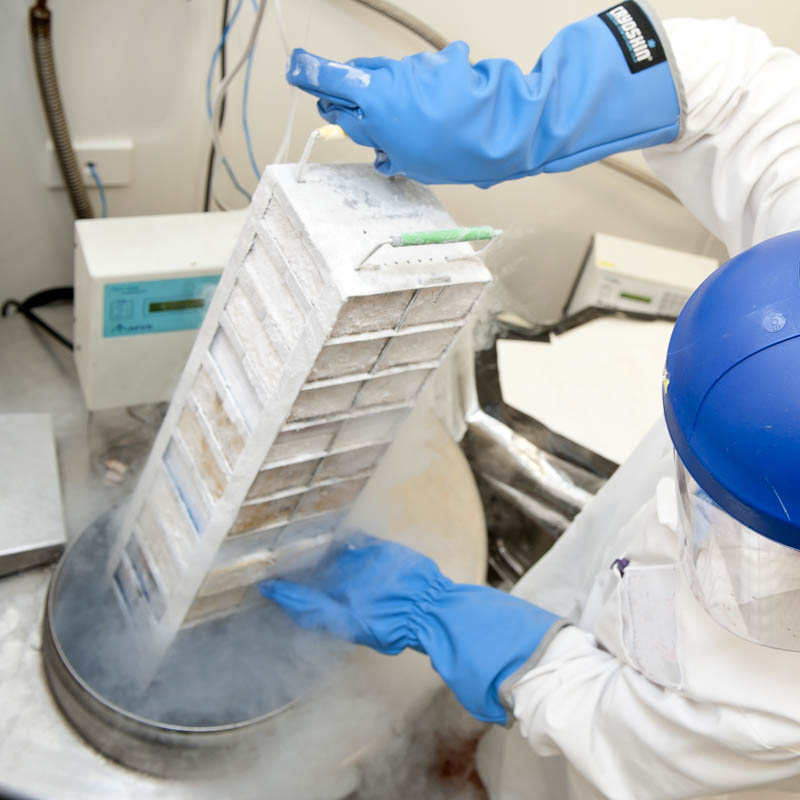
I have no idea how frozen air would look, but it will surely be very, very chilly!(© All Rights Reserved)
I have no idea how frozen air would look, but it will surely be very, very chilly!
(© All Rights Reserved)

Interestingly, frozen air has recently resurfaced as an subject of research interest. As reported last year on various sites such as ecogeek, sustainable business.com and NBC News, a UK-based company Highview Power Storage has developed a proprietary process using cryogenic air (actually nitrogen, liquified at -321 degrees Fahrenheit) as a way to store energy. Available energy is used to freeze/liquify the nitrogen, which is then kept in its frozen form in a highly isolated, giant vacuum flask. When energy is required, the nitrogen is allowed to warm to ambient temperature, and the energy released during its transition to a gas phase, is harvested to drive a turbine that generates electricity.

While the technology is not yet able to achieve the efficiency of current battery technologies, it is a potentially less environmentally harmful, greener approach.

Now there’s a reason to raise a glass of very chilled liquid to James Dewar and his frozen air!

Pyotr Lebedev and the pressure of light

Today we celebrate the birthday of the Russian physicist Pyotr Nikolayevich Lebedev (8 Mar 1866 – 1 Apr 1912).

Working in the field of electromagnetism, Lebedev was responsible for a rather famous physics experiment in 1899 – measuring the pressure a beam of light exerts on a solid body. By doing this, he was the first to quantitatively confirm James Clark Maxwell’s theory of electromagnetism. Not only did he prove that the pressure exerted by light, although minute, is very real – he also proved that the pressure of light on a reflective surface is twice as great as on absorbent surfaces.

Thanks to Pyotr Lebedev we have proof that light exerts physical pressure on a solid body.(© All Rights Reserved)
Thanks to Pyotr Lebedev we have proof that light exerts physical pressure on a solid body.
(© All Rights Reserved)

Lebedev’s discoveries led him to postulate that it was the pressure exerted by sunlight on tiny particles of cosmic dust that made the tail of a comet point away from the Sun. However, it is now generally accepted that solar wind has more effect than light pressure in determining the direction of a comet’s tail.

Lebedev died quite young, yet his achievements was significant enough that the Lebedev Physical Institute in Moscow and the lunar crater Lebedev are named after him.

Stanley Miller, primordial soup and the origin of life

Today we celebrate the birthday of Stanley Lloyd Miller (7 March 1930 – 2 May 2007), the American chemist and biologist known for his experiments into the origin of life.

The most famous of his experiments was the so-called ‘Miller-Urey experiment’, where he and his research partner Harold Urey showed that it was possible, using simple chemical and physical processes, to create organic compounds from inorganic substances. This was considered a logical explanation of how organic life could have started on an planet made up of inorganic chemicals.

In my minds eye I've always imagined primordial soup as a rather ominous-looking pond of bubbling and steaming chemical liquid, very much like the thermal geysers at Rotorua, New Zealand. (© All Rights Reserved)
In my minds eye I’ve always imagined primordial soup as a rather ominous-looking pond of bubbling and steaming chemical liquid, very much like the thermal geysers at Rotorua, New Zealand.
(© All Rights Reserved)

The famous Miller-Urey experiment, conducted in 1952 at the University of Chicago, tried to recreate the conditions existing on the early Earth before organic life existed. The experiment combined a number of chemical compounds – water, methane, ammonia and hydrogen – sealed in an connected loop of glass tubes and flasks. The first flask, containing the chemical mix, was heated to cause evaporation, and the gas was allowed to flow into a second flask where sparks (simulating lightning) were fired between electrodes installed in the flask. The ‘electrocuted gas’ was then cooled again in a subsequent flask, and the condensed liquid was allowed to trickle back into the first flask. This cycle was continued over an extended period.

After about a day, the chemical liquid was reported to turn pink, and after about 2 weeks of operation, Miller and Urey found that some of the carbon in the system had turned into organic compounds. By this stage the mixture included amino acids, sugars, bio-molecules and hydrocarbons.

The Miller-Urey experiments showed, quite compellingly, that simple organic compounds – building blocks for proteins and other organic macromolecules – could be created from basic chemical compounds with the addition of heat and electricity.

The spontaneously created brew of life-yielding organic compounds support the ‘primordial soup’ theory first proposed by Soviet biologist Alexander Oparin in 1924. Very simply stated, the theory suggests that the early Earth’s atmosphere, exposed to various forms of energy, produced simple organic compounds, which accumulated as a ‘soup’ in various locations, and through further transformations, more complex organic polymers were formed, leading ultimately to the formation of water-based organic life forms.

Clarence Birdseye, the father of frozen foods

Our subject for today is frozen foods. According to the Today in Science History website, it was on this day, 6 March 1930, that General Foods first started selling individually packaged frozen foods. Called ‘Birds Eye Frosted Foods’, the idea came from a guy called Clarence Birdseye, who started offering frozen food for sale to the public in 1929, after seeing people thawing and eating frozen fish during a visit to Canada.

Within the first 2 months, sales of the Birds Eye line of frozen foods increased significantly, prompting the start of a huge retail frozen foods industry.

Frozen foods - convenient and practical, and a big part of many daily diets worldwide.(© All Rights Reserved)
Frozen foods – convenient and practical, and a big part of many daily diets worldwide.
(© All Rights Reserved)

Freezing is one of the easiest ways of preserving food for future use, by either killing or inhibiting pathogens that cause food spoilage. It is, however, not as effective as high-temperature treatments since less of the harmful pathogens are killed, and those that are only inhibited are likely to again become active once the frozen foods are thawed. Some spoilage processes are also only slowed down and not stopped, and so frozen foods can typically only be kept for a limited time, particularly in some domestic freezers which may not maintain food at low enough temperatures. Long term storage apparently requires temperatures of 0 °F (-18 °C) or lower. Of course boiling and then freezing food greatly increases the effectiveness of the preservation.

As far as nutritional value is concerned, some vitamin loss is said to occur during freezing, mainly Vitamin C, but also, to a much lesser extent, Vitamins B1, B2 and A.

Despite its limitations, freezing remains one of the most widely used preservation techniques, with frozen pre-cooked meals counting among the most popular products. Its convenience and practical value has made the frozen foods industry a massive multi-national, multi-million dollar industry.

So next time you grab a quick frozen meal from the freezer, think about good old Clarence Birdseye and the Canadians with their frozen fish, who started it all back in the early part of the 20th century.

Laplace and the floating needle

Today we commemorate the death of the man sometimes known as the ‘French Newton’Pierre-Simon Laplace (23 Mar 1749 – 5 Mar 1827).  Laplace was a bit of a super-scientist, excelling in mathematics, physics, statistics and astronomy.

Among other things, Laplace performed fundamental mathematical analyses of the solar system, studied the thermochemical effects of combustion, and did groundbreaking work in mathematical calculus and the solution of linear partial differential equations.

In addition to all his other achievements, Laplace built upon earlier work by English scientist Thomas Young, to explain surface tension in liquids (essentially it’s ability to resist an external force) in terms of the attraction between the molecules in the liquid (known as cohesion). This cohesive force existing in a liquid results in some very interesting natural phenomena, such as enabling a needle to float on water. Some insects use surface tension to allow them to walk on water.

The phenomemon of surface tension can make the seemingly impossible possible, such as allowing a needle  to stay afloat on the surface of normal tap water.(© All Rights Reserved)
The phenomemon of surface tension can make the seemingly impossible possible, such as allowing a needle to stay afloat on the surface of normal tap water.
(© All Rights Reserved)

Laplace also used inter-molecular attraction to developed the theory of capillary action, where a liquid gets ‘sucked into’ a narrow tube due to a combination of cohesive forces within a liquid and adhesive forces between the molecules in the liquid and those in the containing tube.

The capillary pressure difference existing at the interface between two static fluids (e.g. water and air) can be described by a nonlinear partial differential equation, which is, fittingly, known as the Young-Laplace equation.

Despite being one of the great minds of all time, Laplace remained very aware of the limits of his own insights. As he wisely stated near the end of his life, “What we know is little, and what we are ignorant of is immense.”

Calculating ship performance using the Taylor Standard Series

Today we celebrate the birthday of David Watson Taylor (4 March 1864 – 28 July 1940), a naval architect and engineer in the US Navy.

In 1898, Taylor was in charge of constructing the first experimental tank used to study water flow around models of war ships. Using the results from these experiments, he was able to create his lasting legacy – the ‘Taylor Standard Series’, a set of 80 models providing estimates of a ship’s flow resistance, given variations in ship design.

By studying water flow around model ships, David Taylor developed a series of equations to calculate the anticipated performance of a new ship design.(© All Rights Reserved)
By studying water flow around model ships, David Taylor developed a series of equations to calculate the anticipated performance of a new ship design.
(© All Rights Reserved)

While the Taylor Series is limited in the number of parameters that can be varied (it uses only three parameters – slenderness, beam to draft ratio, and prismatic coefficient), these variables are sufficient to provide useful preliminary estimates for most warships and and merchant ships built since Taylor’s time. Taylor’s greatest contribution was his insight that the above three parameters are, in fact, the main factor’s affecting ship performance.

More than a century after its creation, the Taylor Series is still in regular use today, being built into a number of ship synthesis modeling computer programmes.

In honour of Taylor’s work, the Society of Naval Architects and Marine Engineers have created the David W Taylor medal, awarded annually for ‘notable achievement in naval architecture and/or marine engineering.’

Raising awareness about ear and hearing health

It is 3 March, and today is the International Day for Ear and Hearing. Quoting the World Health Organisation’s website, “The day aims to raise awareness and promotes community-based activities for ear and hearing health.”

I found it interesting to discover that hearing loss is the most prevalent sensory disability in the world, with 360 million people worldwide (over 5% of the world’s population) having disabling hearing loss. Hearing loss can be the result of ear infections, but can also be noise induced, caused by disease, or simply be an age related impairment.

Excessively loud music and industrial noises can cause significant hearing loss.(© All Rights Reserved)
Excessively loud music and industrial noises can cause significant hearing loss.
(© All Rights Reserved)

Suffering a hearing loss impacts directly on a person’s ability to communicate and interact with others.  As such hearing impairment has not only social and emotional impact, but also very real economic impact, on the person suffering from hearing loss.

Where hearing loss does occur, benefit can be derived from devices such as hearing aids, assistive devices and cochlear implants. However, the current production of hearing aids meets less than 10% of the global need.

The most important message on this day is that many of the above-mentioned causes of hearing loss is preventable through actions such as immunization, better health care and sound occupational health practices.

Be aware – protect your precious hearing.

The laminated padlock, affordable yet tough

Today we celebrate the birthday of Harry E. Soref (2 Mar 1887 – 1 Mar 1957) an American locksmith and inventor who’s claim to fame is the inventor of the laminated steel padlock.  He also founded the Master Lock Company in 1921.

More than 50 years after Harry Soref's death, Master Lock still produces a wide range of laminated locks.(© All Rights Reserved)
More than 50 years after Harry Soref’s death, Master Lock still produces a wide range of laminated locks.
(© All Rights Reserved)

As a locksmith, Soref knew that standard padlocks didn’t provide sufficient security, as they could easily be broken. To remedy the situation, he came up with the idea of building a lock by laminating layer upon layer of stainless steel together under great pressure. This layered construction, coated with cadmium to rustproof the outer surface, proved to have superior strength compared to other locks of similar manufacturing cost.

Soref tried to sell his idea, but when no-one showed interest, he decided to just make and sell them himself, through his Master Lock company, gaining his first patent for the laminated lock in 1924. The padlock proved to be a great success, and Master Lock grew to be a major lock manufacturer. Today, many lock manufacturers still copy the very efficient and successful design of Soref’s original laminated padlock.

It’s World Compliment Day, so go ahead, make someone’s day!

Today is, believe it or not, World Compliment Day, promoted as the most positive day in the world.

The day started off early in the 21st century in the Netherlands, where this year marks the 11th edition of Compliment Day. Since it’s inception, it has spread to Belgium and Norway, prompting the initiators of the day to re-brand it as an international event, calling it ‘World Compliment Day’.

What makes World Compliment Day ‘better’ than events like Valentine’s Day, Mother’s Day or Secretaries’ Day, is that there’s no commercial connotation – the only gifts you’re meant to give on this day are compliments, and they’re free.

Giving a compliment is the verbal equivalent of giving someone a lovely bunch of flowers.(© All Rights Reserved)
Giving a compliment is the verbal equivalent of giving someone a lovely bunch of flowers.
(© All Rights Reserved)

The American psychologist William James said “The deepest principle in human nature is the craving to be appreciated.” It is this basic human need for recognition and appreciation that is the principle motivation behind Compliment Day. All that is asked of you is to identify something positive about every person you interact with on this day, and compliment them on it – simple as that.

In the words of World Compliment Day initiator Hans Poortvliet, “A sincere and personal compliment costs nothing, but the impact on the recipient is huge. Nothing stimulates more, gives more energy, makes people happier and, as far as business is concerned, increases productivity and commitment faster than sincere appreciation. So why not use it a little bit more?”

The hashtag for the day is #complimentday. Go ahead, make someone’s day!

Scientist extraordinaire Linus Pauling

Today we celebrate the birthday of one of the 20th century’s truly great scientists, Linus Pauling (28 Feb 1901 – 19 Aug 1994). Beyond being a world leading chemist and biochemist, he was also a famous and outspoken peace activist.

Pauling holds the distinction of being the only person to be awarded two unshared Nobel Prizes – the 1954 Nobel Prize in Chemistry (awarded for research into the nature of the chemical bond and its use in elucidating molecular structure) and the 1962 Nobel Peace Prize (for his efforts to ban the testing of nuclear weapons).

As a scientist, Pauling was one of the founders of the fields of quantum chemistry and molecular biology. He did groundbreaking research on the analysis of molecular structures using the experimental technique of x-ray diffraction, complimented by quantum mechanical theory.

Linus Pauling is generally considered the father of molecular biology.(© All Rights Reserved)
Linus Pauling is generally considered the father of molecular biology.
(© All Rights Reserved)

During the later part of his career, Pauling’s interest moved to molecular medicine and medical research. It is during this period that he started promoting the controversial idea of high dosage vitamin C as a treatment for various illnesses, notably cancer. Research conducted by Pauling and the British cancer surgeon Ewan Cameron was reported to show a significantly increased survival rate among terminal cancer patients who were treated with high doses of Vitamin C. These results were, however, later questioned by researchers at the Mayo Institute, who claimed the test group and control group in Pauling’s trial were too dissimilar, with the test group alleged to be less ill than the control group. The Mayo Institute repeated the experiment and found that the Vitamin C had no greater effect than the placebo given to the control group. Pauling, in turn, criticised the Mayo experiment for using oral rather than intravenous Vitamin C, and for not continuing the treatment long enough.

The Mayo results were widely publicised and reduced public interest in the value of high dosage Vitamin C. Pauling, however, continued to study the subject, and kept promoting the treatment as an adjunctive cancer therapy. He also investigated the potential for vitamin C to treat the common cold, to prevent atherosclerosis and to relieve angina pectoris.

Acknowledging his contribution to science, Pauling was included in a list of the 20 greatest scientists of all time by the magazine New Scientist, with Albert Einstein being the only other scientist from the 20th century on the list.